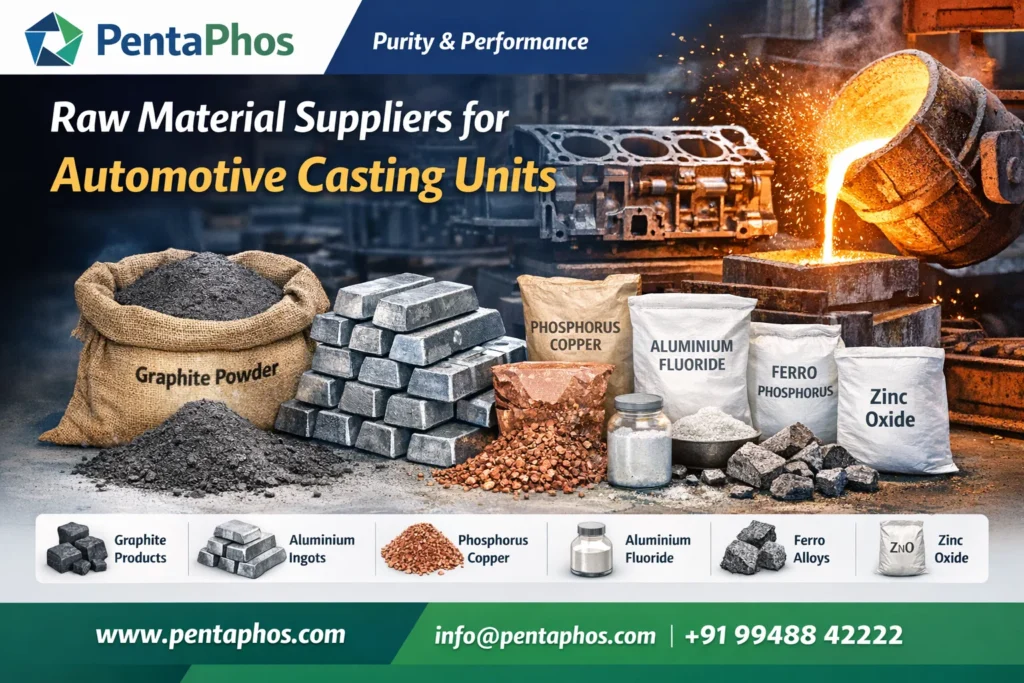
Raw Material Suppliers for Automotive Casting Units – Complete Guide (2026)
In the highly competitive automotive manufacturing industry, selecting the right raw material suppliers for automotive casting units is critical to operational efficiency, product quality, cost control, and customer satisfaction. At Pentaphos, we understand the exacting demands of automotive foundries and casting units, and have created this comprehensive guide to help industry professionals choose the right suppliers, understand pricing, evaluate pros and cons, and get answers to frequently asked questions. Introduction – Why Raw Materials Matter in Automotive Casting Automotive casting units produce crucial components such as engine blocks, transmission cases, suspension parts, and more. These components must meet tight tolerances, high strength standards, and endure extreme operating environments. The performance characteristics of cast components depend heavily on: Choosing the right raw material suppliers for automotive casting units is not just a procurement activity — it’s a cornerstone of manufacturing success. Common Raw Materials Used in Automotive Casting The major raw materials used in automotive casting include: Each material has a direct influence on the final mechanical properties of cast parts such as tensile strength, ductility, hardness, wear resistance, and fatigue life. What Makes a Good Raw Material Supplier for Automotive Casting Units? Before we explore suppliers and pricing, here are the most important attributes automotive casting units should look for: ✅ Consistent Supply & QualitySuppliers must deliver consistent chemical composition and physical properties in every batch. ✅ Certified Material StandardsAdherence to ASTM, ISO, DIN, JIS and automotive OEM specifications. ✅ Technical SupportProfessional metallurgical support for alloy selection, heat treatment guidance, and troubleshooting. ✅ On-time DeliveryTimely deliveries aligned with production schedules. ✅ Competitive Pricing & ValueTransparent costs with quality performance. ✅ Traceability & DocumentationMaterial test certificates (MTC), mill test reports, and batch traceability. These factors not only affect manufacturing quality but also reduce defects, rework, and warranty claims. Top Raw Material Suppliers for Automotive Casting Units (Global & India) Below is a representative list of widely respected suppliers in the automotive casting ecosystem. (This list is illustrative; Pentaphos can help connect with verified partners.) 🔹 Steel & Ferrous Material Suppliers 🔹 Non-Ferrous & Alloy Providers 🔹 Foundry Sand & Refractories 🔹 Specialty Additives & Flux Suppliers These suppliers provide key inputs that directly support the operational excellence of automotive casting units. Raw Material Price Considerations (2026) Raw material prices fluctuate due to global market dynamics, energy costs, freight charges, and input shortages. Accurate costing helps casting units stay profitable and competitive. Raw Material Price Table (Indicative 2026 Average Market Rates) Raw Material Unit Approx Price (INR) Price Range (INR) Pig Iron (Foundry Grade) MT 42,000 38,000 – 45,000 Ferrous Scrap (TMT/Heavy) MT 36,500 34,000 – 39,000 Aluminium Ingots (99.7%) MT 160,000 150,000 – 170,000 Silicon (Si Metal) MT 105,000 98,000 – 115,000 Manganese (Mn) MT 120,000 110,000 – 130,000 Foundry Sand (Silica) MT 3,500 3,000 – 4,000 Refractory Bricks Piece 150 – 400 140 – 450 Fluxing Agents Kg 70 – 120 60 – 150 ⚠️ Note: These prices may vary based on location, supplier, quality grade, and bulk purchase agreements. How Pentaphos Helps Automotive Casting Units At Pentaphos, we support foundries and casting units by providing: 🔹 1. Verified Supplier Network Only authenticated and certified suppliers to ensure quality and reliability. 🔹 2. Material Testing & Certification Complete documentation including MTC, lab reports, and quality certificates. 🔹 3. Logistics & Supply Chain Management Timely delivery with end-to-end tracking and inventory planning support. 🔹 4. Cost Optimization & Negotiation Competitive pricing leveraging bulk contracts and long-term partnerships. 🔹 5. Technical Support & Consultation Assistance with material selection (e.g., ductile iron vs. grey iron), heat-treatment advice, and metallurgy insights. With Pentaphos, casting units can focus on production excellence while we manage material sourcing with transparency and efficiency. Pros & Cons of Different Raw Material Options Here’s a simple comparison to help casting units select raw materials based on performance and cost: Material Category Pros Cons Pig Iron Stable composition; reliable mechanical properties; economical Quality may vary with source; limited versatility Ferrous Scrap Cost-effective; recycled material; wide availability Impurities; inconsistent quality; needs sorting Aluminium Alloys Lightweight; corrosion-resistant; good strength Higher cost; requires controlled melting Foundry Sand (Silica) Good refractoriness; cost-effective Lower thermal stability than Zircon/Chromite Refractories High temperature resistance High cost; limited lifespan Fluxing Agents Improves melt quality; reduces slag Adds cost; improper use affects metallurgy This table helps planners decide what type of raw material mix works best for their casting program. How to Choose the Best Raw Material Supplier Below are best practices that casting units should follow: ✅ 1. Check Certifications Ensure suppliers comply with ISO/TS standards and automotive OEM specifications. ✅ 2. Visit Supplier Facilities (if possible) Factory audits help verify production capabilities. ✅ 3. Evaluate Quality History Ask for past performance data, rejection rates, and customer references. ✅ 4. Quantify Total Cost of Ownership (TCO) Don’t just consider base price — include logistics, quality loss, and scrap rate. ✅ 5. Agree on Supply Agreements Long-term contracts help with price stability and priority supplies. ✅ 6. Ensure Traceability Batch traceability is crucial for automotive components where defect accountability matters. Case Study – Improved Casting Performance with Better Raw Material Choice Problem:A mid-sized automotive casting unit faced high scrap rates (8–10%) due to inconsistent feedstock quality, especially in steel scrap mix. Solution:With Pentaphos intervention: ✔ Switched to certified steel scrap sources✔ Introduced master alloys for better composition control✔ Optimized foundry sand mix with refractory testing✔ Implemented tighter material inspection protocols Result:➤ Scrap reduced to <3%➤ Improved tensile strength consistency➤ Fewer customer complaints➤ Better cost predictability This illustrates how raw material quality directly impacts productivity and profitability. Common Challenges in Raw Material Sourcing Automotive casting units often face challenges such as: ⚠️ Price VolatilityRaw material markets fluctuate with global demand. ⚠️ Supply DisruptionsDelays due to logistics, customs, or production constraints. ⚠️ Quality VariabilityEspecially with recycled scrap and unverified sources. ⚠️ Documentation GapsMissing certificates result in production compliance risks. Pentaphos mitigates these challenges through robust supplier vetting, multi-source strategies, and supply chain management. Frequently Asked Questions (FAQs) 1. What are raw