Author name: flowdigitally

industrial additives for foundry operations
Blog

Industrial Additives for Foundry Operations — A Complete Guide for Manufacturers

Industrial foundries rely heavily on high-performance additives to enhance metal quality, improve castings, and optimize operations. Whether you’re working with iron, steel, aluminium, or specialty alloys, the right additives can transform your production results — improving yield, reducing defects, and lowering overall costs. In this detailed guide, we’ll explore what industrial additives are, why they matter in foundry operations, how a trusted supplier like Pentaphos Industries — Magnesium & Industrial Additives Supplier supports your business, and how to choose, use, and evaluate these materials for maximum value. 🔎 What Are Industrial Additives for Foundry Operations? Foundry additives are chemical and metallurgical materials added at strategic points during melting, alloying, or casting to: ✔ Improve metal fluidity and surface finish✔ Remove impurities like sulfur and oxygen✔ Modify microstructure for better mechanical properties✔ Assist in de-oxidation, desulfurization, inoculation, and alloy control These additives are crucial for controlling: The term “industrial additives for foundry operations” encompasses a wide array of specialized treatment chemicals, alloying agents, desulfurizers, inoculants, fluxing agents, and grain refiners used throughout the casting process. (PW Consulting) 🏭 Overview of Pentaphos Industries Pentaphos Industries is a leading Indian manufacturer and supplier of high-purity magnesium products and industrial additives used across metallurgy, foundry, steelmaking, chemicals, and related sectors. They produce materials such as: Pentaphos emphasizes quality, purity, and performance to support industrial processes, backed by technical consulting, consistent supply, and scalable solutions for bulk orders. (pentaphos) 🧠 Why Additives Matter in Foundry Operations Every foundry process — from melting to solidification — can be influenced by chemical and physical interactions within the molten metal. Industrial additives help address key challenges: 🧪 Purity & Impurity Control ⚙️ Fluidity & Castability 🧰 Microstructure Optimization ♻️ Rework & Yield Efficiency Industrial additives act as precision tools in metallurgical engineering, giving foundries greater control over production quality. (PW Consulting) 📦 Key Industrial Additives Used in Foundries Here are the most common types of additives used in modern foundry operations: 1. Desulfurizers Remove sulfur — a common impurity that embrittles steel and iron. 2. De-oxidizers Reduce oxygen levels to prevent porosity and improve cleanliness. 3. Inoculants Introduce nuclei for controlled solidification, refining grain structure. 4. Alloying Additives Adjust metal chemistry for specific mechanical properties. 5. Fluxing Agents Help dissolve slag and impurities during melting. 6. Modifiers & Grain Refiners Improve mechanical properties and reduce segregation. 7. Carriers & Blends Support optimized delivery and performance based on alloy type. A reliable supplier like Pentaphos can tailor these additives to your specific metal grade, furnace type, and production goals. 💰 Reference Price Table — Foundry Additives Below is a typical price range for industrial additives relevant to foundry operations. These prices are indicative and subject to market demand, contract terms, and customization: Additive Category Typical Price (₹ per kg/MT) Notes Desulfurizers ₹220 – ₹350 / kg Varies with composition & grade De-oxidizers ₹250 – ₹380 / kg Based on purity & specification Inoculants & Modifiers ₹300 – ₹450 / kg Specialty formulations Alloying Batches ₹360 – ₹550 / kg Custom blends for specific grades Fluxing Agents ₹200 – ₹300 / kg Helps slag removal and refining ⚠️ Note: Prices fluctuate based on volume, purity, and bulk contracts. Always request a formal quote from Pentaphos sales to get precise pricing for your order. 📊 Pros & Cons of Industrial Additives for Foundry Operations Before investing in a specific additive strategy, it’s important to understand both the advantages and limitations. ✅ Pros Benefits Explanation Improved Casting Quality Reduces defects like porosity and inclusions Better Mechanical Properties Enhances strength and ductility Higher Yield Less scrap and rework Custom Formulations Tailored additives for specific alloys Support from Experts Technical guidance from suppliers ❌ Cons Limitations Explanation Higher Upfront Cost Premium additives may cost more initially Requires Expertise Needs trained personnel for optimal use Handling & Safety Some additives require strict safety protocols Market Price Volatility Raw material costs impact pricing 🧠 How to Choose the Right Additives Selecting effective industrial additives involves considering several key factors: 📌 Alloy & Metal Type Different metals (steel, ductile iron, aluminium) need distinct additive chemistries. 📌 Furnace Process Additives for induction furnaces may differ from cupola or electric arc furnace requirements. 📌 Desired Properties Consider whether you need improved ductility, surface finish, or mechanical performance. 📌 Dosage & Delivery Proper dosing rates and delivery systems (injection, ladle addition) influence effectiveness. 📌 Technical Support Partnering with a supplier who offers application guidance and testing support improves results. 🚀 Top Applications of Foundry Additives Industrial additives impact several crucial aspects of metal casting: 🏭 Foundry Production Lines Additives help maintain consistent metal quality in high-volume environments. 🏗 Heavy Engineering Castings Improved mechanical properties are essential for parts like crankshafts and gearbox housings. 🚗 Automotive Components Precision additive use delivers tight tolerances and low defect rates. 🔧 Specialty & Alloy Castings Custom additive blends support high-performance alloys and exotic materials. 🧩 FAQ — Industrial Additives for Foundry Operations Q1: What are the most common additives used in foundries?A: Desulfurizers, de-oxidizers, grain refiners, inoculants, and fluxing agents are widely used to improve metal quality and castability. (PW Consulting) Q2: Can Pentaphos customize additives for specific alloys?A: Yes — Pentaphos offers tailored formulations and technical support to match alloy types and production goals. (pentaphos) Q3: Are prices fixed or negotiable?A: Prices vary by specification, volume, and contract terms. Bulk orders and long-term partnerships often receive favorable pricing. Q4: How do additives affect casting defects?A: Proper additives reduce porosity, shrinkage, blowholes, and inclusions — improving tensile strength and surface finish. (PW Consulting) Q5: What safety precautions are required?A: Most additives require PPE, dust control, and proper storage to prevent inhalation and contamination. Q6: Do additives improve yield?A: Yes — reduced scrap, fewer reworks, and controlled chemistry lead to better material utilization. 🧪 Safety & Best Practices in Handling Additives Industrial additives, especially powders and blends, require careful handling: ✔ Use appropriate PPE (masks, gloves, goggles)✔ Control dust and airborne particles✔ Store in cool, dry, labeled containers✔ Follow MSDS and supplier safety guidelines

Magnesium Nodularizer Suppliers in India – A Complete Guide by Pentaphos
Blog

Magnesium Nodularizer Suppliers in India – A Complete Guide by Pentaphos

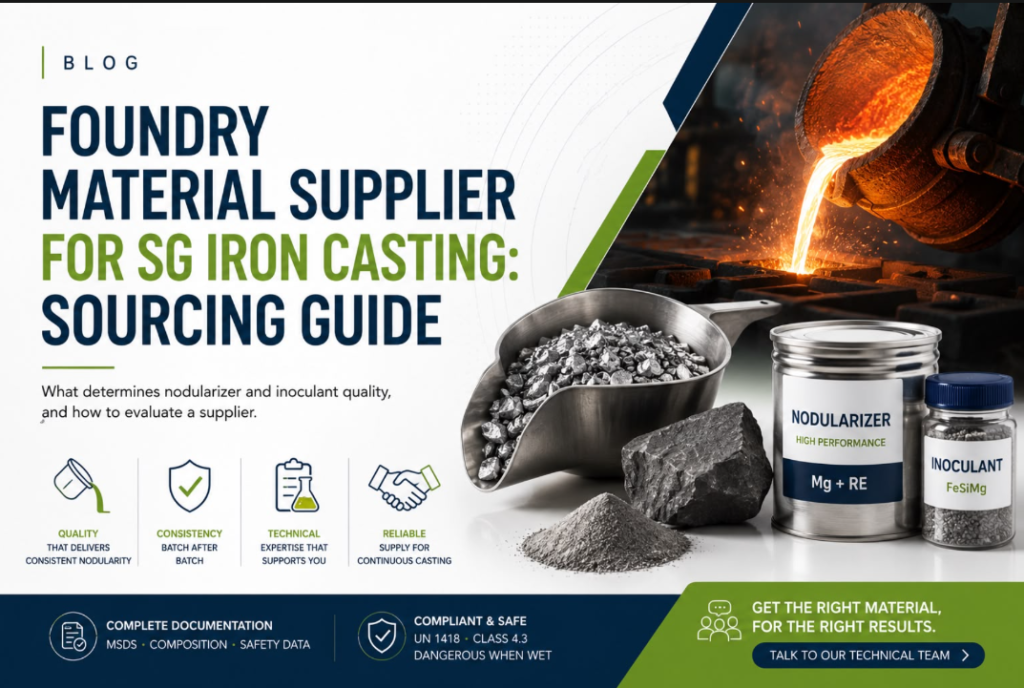
Magnesium nodularizer is a critical alloy additive used in the production of ductile iron (also known as spheroidal graphite iron). It plays a vital role in modifying the shape of graphite from flake to spherical form, significantly improving the mechanical properties of cast iron such as strength, ductility, impact resistance, and machinability. Due to rapid growth in the foundry, automotive, infrastructure, and engineering sectors, the demand for reliable magnesium nodularizer suppliers in India has increased substantially. Pentaphos stands out as a trusted name among magnesium nodularizer suppliers in India, offering consistent quality, competitive pricing, and technical expertise to meet the evolving needs of modern foundries. What is Magnesium Nodularizer? A magnesium nodularizer is an alloy, typically composed of magnesium combined with elements such as ferrosilicon, rare earth metals (REM), calcium, or aluminum. It is added to molten iron during casting to produce nodular (spheroidal) graphite structures. Key Functions Importance of Magnesium Nodularizer in Ductile Iron Production The performance of ductile iron heavily depends on the quality of the nodularizer used. Inferior-quality nodularizers can lead to inconsistent graphite formation, magnesium fade, and casting defects. Choosing reputed magnesium nodularizer suppliers in India like Pentaphos ensures: Types of Magnesium Nodularizers Available in India 1. Ferrosilicon Magnesium (FeSiMg) The most commonly used nodularizer, offering stable magnesium recovery and good inoculation properties. 2. Rare Earth Magnesium Nodularizer Contains rare earth elements to improve graphite nodularity and reduce carbide formation. 3. Low Magnesium Nodularizer Used for thin-wall castings and applications requiring controlled magnesium levels. 4. Custom Alloy Nodularizers Tailor-made compositions based on specific foundry requirements. Pentaphos supplies all major grades, making it a preferred choice among magnesium nodularizer suppliers in India. Applications of Magnesium Nodularizer Why Choose Pentaphos as Your Magnesium Nodularizer Supplier? Pentaphos has built a strong reputation by delivering high-performance metallurgical solutions to foundries across India. Key Advantages When searching for dependable magnesium nodularizer suppliers in India, Pentaphos offers reliability backed by expertise. Quality Standards and Certifications Leading magnesium nodularizer suppliers in India follow stringent quality standards. Pentaphos ensures: Magnesium Nodularizer Price in India Prices may vary depending on magnesium content, rare earth additions, order quantity, and market conditions. Approximate Price Table Grade Type Magnesium Content Packaging Price Range (INR/MT) FeSiMg Standard 5–6% 25 kg bags 1,80,000 – 2,10,000 FeSiMg + REM 6–7% 25 kg bags 2,10,000 – 2,50,000 Low Mg Nodularizer 3–4% 25 kg bags 1,60,000 – 1,90,000 Custom Alloy As required Bulk / Bags On Request Prices are indicative and subject to change. Pros and Cons of Magnesium Nodularizer Pros Advantages Description Improved Strength Enhances tensile and yield strength Better Ductility Increases elongation and impact resistance Reduced Scrap Improves casting consistency Versatility Suitable for various casting applications Cost Efficiency Reduces post-casting defects Cons Limitations Description Magnesium Fade Requires precise process control Handling Risk Magnesium is reactive at high temperatures Cost Variation Prices fluctuate with raw material markets Process Sensitivity Requires skilled foundry practices How to Select the Right Magnesium Nodularizer Supplier in India When evaluating magnesium nodularizer suppliers in India, consider the following: Pentaphos meets all these criteria, making it a reliable long-term partner for foundries. Storage and Handling Guidelines Environmental and Safety Considerations Reputed magnesium nodularizer suppliers in India follow safe manufacturing and handling practices to minimize environmental impact and workplace hazards. Pentaphos prioritizes sustainable sourcing and responsible production. Market Trends for Magnesium Nodularizer in India These trends further strengthen the role of established magnesium nodularizer suppliers in India like Pentaphos. Frequently Asked Questions (FAQs) 1. What is the role of magnesium nodularizer in cast iron? It converts graphite into spheroidal form, improving mechanical properties. 2. Who are the trusted magnesium nodularizer suppliers in India? Pentaphos is among the most reliable magnesium nodularizer suppliers in India. 3. What is the ideal magnesium content? Typically between 3% to 7%, depending on application requirements. 4. Can nodularizer composition be customized? Yes, Pentaphos offers customized alloy solutions. 5. What factors affect magnesium recovery? Temperature, treatment method, and alloy composition. 6. Is rare earth addition necessary? It helps improve nodularity and reduce carbides in certain applications. 7. How is magnesium nodularizer packaged? Usually in 25 kg moisture-resistant bags or bulk packaging. 8. What industries use magnesium nodularizer? Automotive, pipes, infrastructure, agriculture, and heavy engineering. Conclusion The quality of ductile iron castings depends heavily on the choice of nodularizer. Selecting experienced magnesium nodularizer suppliers in India ensures better metallurgical performance, cost efficiency, and production reliability. Pentaphos, with its commitment to quality, innovation, and customer satisfaction, stands as a trusted partner for foundries across India. If you are looking for consistent performance and expert support, Pentaphos is your ideal magnesium nodularizer supplier.

Magnesium Products for Critical Engineering Applications
Blog

Magnesium Products for Critical Engineering Applications

High-Performance Materials for Tomorrow’s Technologies In advanced engineering industries, the choice of materials is a critical decision that directly affects performance, reliability, safety, and cost-efficiency. Among the range of metals used today, magnesium products for critical engineering applications have emerged as a strategic choice due to their exceptional combination of properties — including lightweight, strength-to-weight ratio, thermal conductivity, and machinability. This in-depth article explores everything you need to know about magnesium products, applications, benefits, limitations, pricing, and FAQs to help engineers, designers, and procurement teams make informed decisions. 1. Introduction: Why Magnesium Matters in Engineering Magnesium, the lightest structural metal in practical engineering use, has carved its niche across key industries such as aerospace, automotive, electronics, energy, and defense. When engineered correctly, magnesium alloys and components can outperform heavier materials like aluminum and steel, enabling improvements in fuel efficiency, structural integrity, and overall system performance. Magnesium is particularly valuable in critical engineering applications where every gram counts and performance cannot be compromised. 2. What Makes Magnesium Products Ideal for Engineering Applications? Magnesium products for critical engineering applications stand out due to the following attributes: 2.1. Unmatched Lightweight Property 2.2. High Strength-to-Weight Ratio 2.3. Excellent Thermal Conductivity 2.4. Good Machinability 2.5. Electromagnetic Shielding 3. Common Magnesium Products for Critical Engineering Applications A wide variety of magnesium products are used to meet the demands of sophisticated engineering systems. These include: 3.1. Magnesium Alloy Ingots Used as raw material for further manufacturing and casting processes. 3.2. Die-Cast Magnesium Components Precision-engineered parts used in aerospace control systems, automotive housings, and electronic enclosures. 3.3. Magnesium Extrusions Structural sections used in framework, supports, and chassis components. 3.4. Sheets, Plates, and Foils Used in shielding, energy systems, and lightweight structural panels. 3.5. Custom CNC Machined Parts High-precision components tailored for critical mechanical applications. 3.6. Magnesium Powders For advanced manufacturing such as additive manufacturing (metal 3D printing) and powder metallurgy. 4. Key Engineering Applications of Magnesium Products Magnesium products are used across crucial sectors: 4.1. Aerospace 4.2. Automotive 4.3. Electronics and Electrical Systems 4.4. Defense and Military 4.5. Energy and Power Systems 5. Price Comparison: Magnesium Products for Critical Engineering Applications Below is a representative pricing table for commonly used magnesium products. Prices are approximate and vary based on volume, alloy grade, custom specifications, and market conditions: Product Type Typical Price (USD) Unit Magnesium Alloy Ingots $2.50 – $3.50/kg per kilogram Die-Cast Magnesium Component (Standard) $15 – $45 per piece Extruded Magnesium Profiles $5.00 – $12.00/kg per kilogram Magnesium Sheets & Plates (Standard) $4.00 – $9.00/kg per kilogram Custom CNC Machined Parts $50 – $300+ per piece (varies) Magnesium Powder $4.50 – $8.50/kg per kilogram Note: These are indicative prices. Custom tolerances, finishes, alloy grades, and production volumes influence final costs. 6. Advantages of Magnesium Products Below is a pros table showcasing why engineers choose magnesium: Advantages Description Lightweight Significantly lighter than aluminum and steel High Strength-to-Weight Ratio Ideal for structural components Excellent Thermal Conductivity Great heat-dissipation properties Good Machinability Reduces machining time and tooling costs EMI/RFI Shielding Capabilities Useful in electrical/electronic applications Recyclability Magnesium is recyclable with minimal quality loss 7. Limitations and Challenges No material is perfect. Here are some cons of magnesium products in engineering: Limitations Impact Corrosion Risk Requires surface treatments (anodizing, coatings) Cost Sensitivity Prices fluctuate with alloy grades and global demand Lower Fatigue Strength vs Some Alloys May require engineering optimization for cyclic loads Flammability Concerns (Powder/Chips) Special handling required during manufacturing 8. How to Select the Right Magnesium Product Proper material selection is essential. Follow these steps: 8.1. Define Application Requirements 8.2. Choose Appropriate Alloy and Grade Common engineering alloys include AZ (Aluminum-Zinc), AM (Aluminum-Manganese), and WE (Rare Earth-based alloys) — each offering specific strength or corrosion resistance features. 8.3. Consider Manufacturing Method 8.4. Surface Finishing and Treatment To combat corrosion or improve surface properties: coatings, anodizing, plating, or painting. 8.5. Test and Validate Prototype testing, finite element analysis (FEA), and lifecycle assessments help verify performance before full production. 9. Surface Treatments for Enhanced Performance Magnesium is reactive and needs protection for long-term performance: 9.1. Anodizing Increases corrosion resistance and surface hardness. 9.2. Conversion Coatings Chromate, phosphate, or rare-earth conversion layers prevent oxidation. 9.3. Powder Coating Improves aesthetics and corrosion resistance. 9.4. Painting and Sealing Protects from environmental conditions and enhances durability. 10. Industry Case Study Examples 10.1. Aerospace Structural Panels Using magnesium die-cast parts reduced aircraft component weight by up to 30%, improving fuel economy and payload capacity. 10.2. Automotive Powertrain Components Magnesium engine and transmission housings increased efficiency while maintaining structural integrity under stress. 10.3. High-Performance Electronics Heat sinks and EMI shielding parts improved thermal management and electrical performance in compact devices. 11. Sustainability and Recycling Magnesium is among the most recyclable engineering metals. The recycling process: This makes magnesium a responsible choice for companies focused on green engineering and sustainable manufacturing. 12. Common Misconceptions About Magnesium in Engineering Misconception 1: Magnesium Is Too Weak for Structural Use Fact: Modern magnesium alloys have been engineered to meet rigorous strength and fatigue requirements. Misconception 2: Magnesium Rusts Easily Fact: With proper surface treatment, magnesium performs well in harsh environments. Misconception 3: Machining Magnesium Is Dangerous Fact: Safe machining practices and dust management systems mitigate fire risk. 13. Price vs. Performance: Value Analysis When evaluating magnesium products for critical engineering applications, it’s important to balance cost with functional value: Engineering teams should consider total cost of ownership (TCO) rather than just upfront material cost. 14. Quality Standards and Testing Protocols Trusted manufacturers follow strict standards including: These quality controls ensure that magnesium parts meet the rigorous requirements of critical engineering applications. 15. FAQs: Magnesium Products for Engineering Q1: What are the typical industries using magnesium products? A: Aerospace, automotive, electronics, defense, medical devices, power systems, and renewable energy sectors use magnesium for lightweight and performance benefits. Q2: Are magnesium products expensive? A: Magnesium can be cost competitive when evaluated on performance benefits, manufacturing efficiency, and lifecycle advantages. Prices vary based on grade, processing method, and specifications. Q3: Is magnesium corrosion-resistant?

Magnesium Alloy Feedstock Wholesalers in India: Complete Industry Guide
Blog

Magnesium Alloy Feedstock Wholesalers in India: Complete Industry Guide

India’s manufacturing ecosystem is rapidly evolving, with lightweight, high-strength materials becoming a top priority across industries such as automotive, aerospace, electronics, defense, and precision engineering. Among these advanced materials, magnesium alloys stand out for their exceptional strength-to-weight ratio, corrosion resistance (with proper treatment), and excellent machinability. This growing demand has positioned magnesium alloy feedstock wholesalers in India as critical enablers of modern manufacturing. At Pentaphos (https://pentaphos.com/), we specialize in supplying high-quality magnesium alloy feedstock tailored for industrial, machining, and metallurgical applications. This comprehensive guide explains magnesium alloy feedstock, its applications, benefits, challenges, pricing structure, and why Pentaphos is a trusted name among magnesium alloy feedstock wholesalers in India. What Is Magnesium Alloy Feedstock? Magnesium alloy feedstock refers to raw or semi-processed magnesium alloy material used as input for manufacturing and machining processes. It is commonly supplied in the form of: These feedstocks are further processed through casting, extrusion, rolling, or CNC machining to create finished components. Magnesium alloys typically contain elements such as aluminum, zinc, manganese, rare earth metals, or silicon to enhance mechanical properties, corrosion resistance, and thermal stability. Why Magnesium Alloys Are in High Demand The global and Indian manufacturing sectors are shifting toward lightweight metals to improve efficiency, reduce fuel consumption, and lower emissions. Magnesium alloys offer: Because of these advantages, magnesium alloy feedstock wholesalers in India are seeing increasing demand from OEMs and Tier-1 suppliers. Applications of Magnesium Alloy Feedstock Automotive Industry Aerospace & Defense Electronics & Electrical Industrial & Machinery Metallurgy & Chemical Processing Pentaphos supplies magnesium alloy feedstock optimized for all the above applications. Types of Magnesium Alloys Supplied in India Common magnesium alloy grades available through leading wholesalers include: Each alloy is selected based on strength, ductility, corrosion resistance, and operating temperature. Role of Magnesium Alloy Feedstock Wholesalers in India Reliable wholesalers play a crucial role in: Pentaphos acts not just as a supplier but as a solution partner, supporting customers from material selection to final delivery. Why Choose Pentaphos as Your Magnesium Alloy Feedstock Supplier 1. Assured Quality All magnesium alloy feedstock supplied by Pentaphos undergoes strict quality checks to ensure chemical composition accuracy and metallurgical consistency. 2. Wide Product Range From ingots to machining chips, we offer multiple forms of magnesium alloy feedstock under one roof. 3. Competitive Pricing Our strong sourcing network allows us to offer market-competitive prices without compromising quality. 4. Custom Solutions We provide tailored packaging, batch sizes, and alloy compositions based on your industrial requirements. 5. Pan-India Supply As one of the trusted magnesium alloy feedstock wholesalers in India, we serve clients across major industrial hubs. Magnesium Alloy Feedstock Price in India Pricing depends on alloy grade, purity, form, order quantity, and market conditions. Indicative Price Table Product Type Alloy Grade Purity Approx. Price (INR/Kg) Magnesium Alloy Ingots AZ91 99.8% ₹420 – ₹520 Magnesium Alloy Billets AZ31 99.7% ₹450 – ₹550 Magnesium Alloy Rods AM60 99.8% ₹480 – ₹600 Magnesium Alloy Chips Mixed Grades 99.5% ₹350 – ₹450 Customized Feedstock As Required As Specified On Request Prices are indicative and may vary based on quantity and market volatility. Pros and Cons of Magnesium Alloy Feedstock Pros and Cons Table Pros Cons Extremely lightweight Higher cost than aluminum Excellent machinability Requires corrosion protection High strength-to-weight ratio Flammability risk if mishandled Good vibration damping Limited high-temperature performance Recyclable and eco-friendly Needs skilled handling and storage Pentaphos ensures safe handling guidance and quality packaging to mitigate these challenges. Storage and Safety Guidelines Magnesium alloys require careful handling due to their reactive nature: Our team provides detailed safety documentation with every supply. Sustainability and Recycling Magnesium alloys are 100% recyclable without loss of properties. Using recycled magnesium feedstock: Pentaphos actively promotes responsible sourcing and recycling practices. Future of Magnesium Alloy Feedstock in India With the rise of EVs, aerospace localization, and lightweight engineering, demand for magnesium alloys in India is expected to grow significantly. Government initiatives like Make in India and increasing R&D investments further support this growth. Magnesium alloy feedstock wholesalers in India, like Pentaphos, are poised to play a major role in this transformation. Frequently Asked Questions (FAQs) 1. What is magnesium alloy feedstock used for? It is used as raw material for casting, machining, and alloying in automotive, aerospace, electronics, and industrial applications. 2. Is magnesium alloy stronger than aluminum? Magnesium alloys are lighter than aluminum and offer comparable strength in many applications, making them ideal for weight-sensitive designs. 3. Who are reliable magnesium alloy feedstock wholesalers in India? Pentaphos is a trusted supplier known for quality, consistency, and technical expertise. 4. What forms of magnesium alloy feedstock are available? Ingots, billets, rods, chips, granules, and customized forms. 5. Is magnesium alloy safe to use? Yes, when handled and stored correctly following safety guidelines. 6. Can Pentaphos supply bulk quantities? Yes, we specialize in bulk and customized industrial supply across India. 7. How is pricing determined? Pricing depends on alloy grade, purity, form, quantity, and market conditions. Contact Pentaphos If you are looking for reliable magnesium alloy feedstock wholesalers in India, Pentaphos is your trusted partner. Visit: https://pentaphos.com/ Get in touch today for technical consultation, bulk pricing, and customized solutions. Pentaphos – Powering Advanced Materials for Modern Manufacturing

Casting Chemical Raw Material Suppliers in India
Blog

Casting Chemical Raw Material Suppliers in India – Complete Guide by Pentaphos

India is one of the fastest-growing manufacturing hubs in the world, and the foundry and casting industry plays a vital role in this growth. From automotive components to heavy machinery, construction equipment, railways, and infrastructure projects, metal casting is at the core of industrial development. To achieve consistent quality, strength, and performance in cast products, foundries rely heavily on casting chemical raw materials. Choosing reliable casting chemical raw material suppliers in India is not just about pricing—it directly impacts casting quality, production efficiency, rejection rates, and long-term profitability. Pentaphos has emerged as a trusted name in supplying high-quality casting chemicals and raw materials to foundries across India. In this detailed guide, we will explore casting chemical raw materials, their applications, benefits, pricing, pros and cons, and why Pentaphos stands out as one of the leading casting chemical raw material suppliers in India. What Are Casting Chemical Raw Materials? Casting chemical raw materials are specialized compounds used during the metal casting process to improve metal quality, control reactions, enhance mechanical properties, and reduce defects. These materials are added at different stages of casting such as melting, pouring, molding, and finishing. Commonly used casting chemicals include: Each chemical has a specific function and contributes to achieving defect-free, high-strength castings. Importance of Casting Chemical Raw Materials in Foundries The quality of raw materials defines the quality of the final casting. Using substandard or inconsistent chemicals can lead to: Reliable casting chemical raw material suppliers in India ensure consistent chemical composition, reliable performance, and technical support—helping foundries meet international quality standards. Key Casting Chemical Raw Materials Supplied by Pentaphos 1. Magnesium Desulfurizers Magnesium-based desulfurizers are widely used to reduce sulfur content in molten iron. Lower sulfur improves ductility, machinability, and overall metal quality. Applications: 2. Inoculants Inoculants help control the microstructure of cast iron by promoting uniform graphite formation. Benefits: 3. Fluxes Fluxes remove impurities from molten metal and improve fluidity. Benefits: 4. Nodulizers Nodulizers are essential in ductile iron production to convert flake graphite into spheroidal graphite. 5. Deoxidizers Deoxidizers remove excess oxygen from molten metal, preventing porosity and blowholes. 6. Exothermic Riser Compounds These compounds ensure proper feeding of molten metal during solidification, reducing shrinkage defects. Why Choose Pentaphos as a Casting Chemical Raw Material Supplier in India? Pentaphos is recognized among the most reliable casting chemical raw material suppliers in India due to its commitment to quality, innovation, and customer satisfaction. Key Advantages of Pentaphos: Applications of Casting Chemicals Across Industries Casting chemical raw materials supplied by Pentaphos are widely used in: Price Table – Casting Chemical Raw Materials in India Product Name Typical Price Range (INR/kg) Application Magnesium Desulfurizer ₹180 – ₹350 Sulfur reduction in molten iron Inoculants ₹120 – ₹280 Grain structure control Fluxes ₹60 – ₹150 Slag removal and purification Nodulizers ₹220 – ₹450 Ductile iron production Deoxidizers ₹90 – ₹200 Oxygen control Exothermic Compounds ₹70 – ₹180 Shrinkage prevention Note: Prices may vary based on quantity, grade, and market conditions. Pros and Cons of Using Casting Chemical Raw Materials Pros Advantages Description Improved Casting Quality Enhances strength and microstructure Reduced Defects Minimizes shrinkage, porosity, and inclusions Higher Productivity Faster processing and fewer rejections Cost Efficiency Long-term savings due to reduced wastage Consistent Results Stable chemical performance Cons Limitations Description Initial Cost High-quality chemicals may cost more Technical Knowledge Required Proper dosing is essential Storage Sensitivity Some chemicals require controlled storage How to Choose the Right Casting Chemical Raw Material Supplier in India When selecting a supplier, consider the following factors: Pentaphos meets all these criteria, making it a preferred choice among foundries. Quality Standards Followed by Pentaphos Pentaphos follows stringent quality control measures to ensure all casting chemical raw materials meet industry standards: Sustainability and Environmental Responsibility Modern foundries focus on sustainability. Pentaphos supports eco-friendly practices by: Frequently Asked Questions (FAQs) 1. What are casting chemical raw materials? Casting chemical raw materials are compounds used to improve metal quality, reduce defects, and enhance casting performance. 2. Why are reliable casting chemical raw material suppliers in India important? Reliable suppliers ensure consistent quality, reduce rejections, and improve overall foundry efficiency. 3. Does Pentaphos supply customized casting chemicals? Yes, Pentaphos offers customized formulations based on specific foundry requirements. 4. What industries use casting chemicals? Automotive, infrastructure, railways, heavy engineering, and machinery manufacturing industries. 5. Are Pentaphos casting chemicals suitable for export-quality castings? Yes, Pentaphos products meet international quality standards suitable for export-oriented foundries. 6. How can I get pricing details from Pentaphos? You can visit https://pentaphos.com/ or contact their sales team directly for quotations. Conclusion The success of any foundry depends heavily on the quality of its raw materials. Choosing the right casting chemical raw material suppliers in India can significantly enhance product quality, reduce costs, and improve operational efficiency. Pentaphos stands out as a trusted partner for foundries looking for high-performance, reliable, and cost-effective casting chemical solutions. With a wide product range, competitive pricing, and strong technical expertise, Pentaphos continues to support the growth of India’s casting industry and remains a preferred choice for foundries nationwide.

magnesium material supplier for machining operations
Blog

Magnesium Material Supplier for Machining Operations | Premium Magnesium Alloys & Services by Pentaphos

In modern manufacturing, choosing the right materials is just as critical as choosing the right machining process. Among lightweight metals, magnesium stands out as a high-performance option — especially for industries such as automotive, aerospace, medical, electronics, and precision engineering. However, sourcing reliable magnesium materials tailored for precision machining operations is a challenge that many manufacturers face. This is where Pentaphos comes in — as your trusted magnesium material supplier for machining operations, we deliver premium magnesium alloys, expert support, and exceptional value to elevate your production outcomes. 🧠 What Makes Magnesium a Preferred Material for Machining? Magnesium is the lightest structural metal available for commercial use — around 33% lighter than aluminum and 75% lighter than steel. Its combination of low density, excellent strength-to-weight ratio, good damping capacity, and machinability makes it ideal for components where weight reduction and performance are priorities. Key advantages of magnesium in machining: These qualities make magnesium alloys highly sought after for precision parts, housings, brackets, and structural components. 🏭 About Pentaphos: Your Trusted Magnesium Material Supplier for Machining Operations Pentaphos is a leading global supplier of magnesium materials specifically developed for machining operations. With decades of experience in materials engineering and logistics, Pentaphos serves manufacturers who demand consistency, performance, and competitive pricing. We supply: Our commitment to quality, delivery performance, and technical support makes us the preferred partner for machining shops around the world. 🔍 Magnesium Grades & Specifications We Supply We supply a range of magnesium alloys designed for different machining requirements. Each grade has distinct characteristics that suit specific applications: Grade Typical Composition Properties Best Use Cases AZ31B Mg-Al-Zn Good formability, moderate strength Automotive panels, brackets AZ61A Mg-Al-Zn Higher tensile strength than AZ31 Aerospace, structural parts AZ91D Mg-Al-Zn (High Al) Excellent corrosion resistance Electronics, housings WE43 Mg-Y-Rare Earth High heat resistance, high strength Aerospace, medical ZK60 Mg-Zn-Zr High strength & fatigue resistance Precision engineering Note: All materials are supplied with full mill test certificates (MTC), traceability, and quality documentation. 💰 Magnesium Material Price List for Machining Operations Pricing for magnesium materials varies by grade, size, quantity, and market conditions. Below is a general price table to give you an estimate. 📌 Note: All prices are indicative and subject to change based on global metal markets, order volume, delivery location, and custom requirements. Material / Grade Form Size Range Price (USD/kg)* MOQ AZ31B Billet Ø50–Ø200 mm $4.50 – $5.50 500 kg AZ61A Bar Ø25–Ø150 mm $5.00 – $6.00 500 kg AZ91D Plate 10–50 mm $5.50 – $6.50 300 kg WE43 Billet Ø50–Ø200 mm $12.00 – $15.00 300 kg ZK60 Bar Ø25–Ø125 mm $8.00 – $10.00 300 kg Custom Sizes Machining Ready As per request On Request On Request *Prices exclude shipping and taxes. 🔧 Why Pentaphos Magnesium Materials Are Ideal for Machining Operations Choosing the right supplier affects efficiency, waste, tool life, and part quality. Here’s how Pentaphos stands out: ✅ Precision Machining Compatibility ✅ Consistent Quality & Traceability Every batch of magnesium material we supply undergoes strict quality checks, ensuring metallurgical integrity and performance consistency. ✅ Technical Support and Material Selection Our experts help you choose the best magnesium grade based on your machining process — whether CNC turning, milling, drilling, or high-speed applications. 📈 Benefits of Using Magnesium in Machining (Pros) Here’s a quick look at why magnesium is preferred for high-precision machining: Pros of Magnesium Explanation Lightweight Reduces part weight, ideal for aerospace & automotive Excellent Machinability Easy chip formation, longer tool life High Strength-to-Weight Ratio Strong performance with minimal weight Reduced Cycle Time Fast cutting speeds improve productivity Good Thermal Conductivity Efficient heat dissipation during machining Environmentally Friendly Recyclable with lower energy requirements ⚠️ Considerations When Using Magnesium (Cons) While magnesium is an excellent material, there are practical considerations to keep in mind: Cons of Magnesium Explanation Flammability Risks Magnesium dust can ignite; requires safety protocols Cost Variation Price can fluctuate with global markets Corrosion Resistance Some grades need protective coatings Limited High-Temperature Performance Not suitable for extreme heat environments Our technical team provides guidance on mitigating these challenges and selecting the right grade and safety measures. 🛠 Expert Tips for Machining Magnesium To make the most of magnesium’s benefits in machining: 🟡 Use Sharp Cutting Tools Sharp, carbide-tipped tools provide cleaner cuts and reduce heat build-up. 🔵 Control Coolant Use dry machining or minimal lubricant with proper chip evacuation — magnesium reacts with some coolants. 🟢 Ensure Fire Safety Always follow fire-prevention protocols — especially with finer chips and higher cutting speeds. 🟣 Maintain Proper Ventilation Good airflow reduces the risk of fire and ensures chip removal. Pentaphos provides guidance on machining best practices based on your application. 📦 Supply Chain & Delivery Excellence At Pentaphos, we understand that supply reliability is critical to production continuity. 📍 What You Get We aim to streamline your supply chain and eliminate production bottlenecks. 🧩 Industries That Rely on Magnesium Materials Here’s how magnesium materials supplied by Pentaphos are used across industries: 🚗 Automotive ✈️ Aerospace 🏥 Medical Devices 📡 Electronics ⚙️ Precision Engineering 🧱 Custom Magnesium Solutions At Pentaphos, we understand that one size does not fit all. We offer: Whatever your project specification — large or small — our team collaborates closely to deliver what you need. ❓ Frequently Asked Questions (FAQs) Q1: What makes magnesium suitable for machining operations?A: Magnesium is lightweight, highly machinable, and offers excellent dimensional stability, which is why it’s widely used in precision machining for automotive, aerospace, and electronics parts. Q2: Can Pentaphos supply custom sizes for magnesium billets or bars?A: Yes — we offer custom sizes based on customer specifications. Contact our sales team with your requirements. Q3: Are Pentaphos magnesium materials certified?A: Yes — all materials come with full mill test certificates (MTC) and quality documentation, ensuring traceability. Q4: What safety precautions are needed when machining magnesium?A: Because magnesium chips and dust can ignite, proper fire safety protocols, ventilation, and sharp tooling are essential. Our technical team provides guidance. Q5: How do I choose the right magnesium alloy for my

lightweight metal suppliers for automotive industry
Blog

Lightweight Metal Suppliers for Automotive Industry

In the rapidly evolving automotive sector, manufacturers are constantly seeking ways to improve performance, fuel efficiency, and sustainability. One of the most impactful strategies is the use of lightweight metals. Partnering with trusted lightweight metal suppliers for automotive industry needs is crucial for OEMs, Tier-1s, and engineering teams striving for excellence. Pentaphos (https://pentaphos.com/) stands out as a global leader in supplying lightweight metals tailored to the automotive industry’s stringent demands. This guide explores the benefits, pricing, applications, and FAQs related to lightweight metals — all while highlighting why Pentaphos should be your go-to supplier. 🔍 Why the Automotive Industry Needs Lightweight Metals The automotive industry faces mounting pressure to: Lightweight materials deliver on all these fronts. Traditional steels are being replaced with advanced metals like aluminum alloys, magnesium, titanium, and high-strength steels — all offered by top lightweight metal suppliers for automotive industry partners like Pentaphos. 🛠 Common Lightweight Metals Used in Automobiles Metal Type Key Properties Typical Automotive Use Aluminum Alloys High strength-to-weight ratio, corrosion resistance Body panels, engine parts, wheels Magnesium Alloys Extremely lightweight Structural components, housings Titanium High strength, heat resistance Exhaust systems, critical fasteners High-Strength Steels Better strength than mild steel Safety cages, chassis parts 🌍 Pentaphos: Trusted Lightweight Metal Suppliers for Automotive Industry Pentaphos has decades of experience in delivering premium metals to sectors like aerospace, defense, and especially automotive. Their customer-centric approach and quality-driven supply chain make them one of the most trusted lightweight metal suppliers for automotive industry requirements worldwide. Key Features of Pentaphos Supply Services 🚘 Automotive Applications of Lightweight Metals 1. Engine Components Lightweight metals reduce reciprocating mass, leading to better fuel economy and lower emissions. Aluminum and magnesium are preferred for engine blocks, pistons, and cylinder heads. 2. Chassis and Structural Parts High-strength aluminum alloys and advanced steels improve crashworthiness while keeping weight down. 3. Exterior & Interior Panels Aluminum panels decrease vehicle weight without compromising aesthetics or durability. 4. Electric Vehicle (EV) Battery Housings Light metals help offset the considerable weight of EV battery packs. 💡 Benefits of Choosing Pentaphos as Your Supplier When evaluating lightweight metal suppliers for automotive industry, here’s what sets Pentaphos apart: Benefit Description High Quality Metals meet automotive industry standards (ISO, ASTM) Custom Solutions Can tailor metals & alloys per design needs Scalability Supplies from prototypes to mass production Consistent Delivery Reliable logistics & inventory management Technical Support Alloy selection & consultation provided 💰 Price Table: Lightweight Metals for Automotive Industry Note: Prices shown are indicative and may vary based on global metal markets, order volume, alloy grade, and delivery location. Contact Pentaphos for exact quotes. Material Typical Price (per kg) Notes Aluminum Alloys (e.g., 6061, 7075) $2.50 – $4.00 Widely used in structural & body parts Magnesium Alloys (AZ31, ZK60) $3.50 – $6.00 Ultralight but more reactive metal Titanium (Grade 5 & 2) $20.00 – $35.00 High performance, high cost High-Strength Steel $1.00 – $1.50 Heavy vs alloys, but strong & cost-effective ⚙️ Pros & Cons of Lightweight Metals in Automotive Use Pros 🟢 Cons 🔴 Improved Fuel Efficiency Higher material cost (especially titanium) Reduced Emissions Some alloys require special welding/fabrication Higher Performance & Speed Corrosion (magnesium needs protective coatings) Better Handling Supply chain price volatility Enhanced EV Range Recycling infrastructure still developing 🧠 How Pentaphos Supports Sustainable Automotive Manufacturing Sustainability is a major focus for automotive OEMs today. Pentaphos supports green manufacturing by: This aligns Pentaphos with global goals like lower carbon footprint and circular economy principles. 🔧 Selecting the Right Supplier: What Automotive Buyers Should Look For When comparing lightweight metal suppliers for automotive industry, keep these criteria in mind: ✅ 1. Material Certification Ensure supplier provides full traceability and certified alloy specifications. ✅ 2. Consistent Quality Automotive parts must meet exact tolerances and performance standards. ✅ 3. Reliable Delivery Delays can disrupt production lines — choose suppliers with logistical strength. ✅ 4. Technical Expertise A partner that helps you choose correct alloys saves time and cost. ✅ 5. Competitive Pricing Transparent pricing with volume discounts helps large manufacturers. Pentaphos meets all these benchmarks and continues to serve automotive clients globally. ❓ Frequently Asked Questions (FAQs) 1. What are lightweight metals used for in the automotive industry? Lightweight metals such as aluminum, magnesium, and titanium are used to reduce vehicle weight, improve fuel economy, and enhance performance. They are found in structural parts, body panels, engine components, and EV battery housings. 2. Why is aluminum a preferred choice among lightweight metals? Aluminum offers an excellent balance of strength, weight savings, and corrosion resistance. It is also more cost-effective than titanium and widely recyclable, making it ideal for automotive applications. 3. Which manufacturers require lightweight metal suppliers? OEMs, Tier-1 parts manufacturers, EV startups, and aerospace-grade automotive studios all require trusted suppliers for lightweight metals. 4. Are prices for lightweight metals stable? No. Prices can vary due to global commodity market fluctuations, supply chain conditions, and demand trends. Pentaphos provides real-time pricing and competitive quotes. 5. How does Pentaphos ensure quality? Pentaphos partners with certified mills and implements rigorous quality inspection protocols, ensuring that every batch meets automotive industry standards. 6. Can Pentaphos supply custom alloys? Yes. Pentaphos can source and deliver specialty alloys tailored to specific automotive designs or performance requirements. 🏁 Conclusion Choosing the right lightweight metal suppliers for automotive industry is more than just a procurement decision — it’s a strategic investment in performance, efficiency, and future-readiness. Pentaphos stands out as a trusted, quality-focused supplier with decades of experience helping automotive manufacturers achieve their goals. If your company is looking to reduce vehicle weight, enhance performance, or meet sustainability targets, Pentaphos is the ideal partner for all your lightweight metal needs. 👉 Get in touch with Pentaphos today to request a quote and discuss customized material solutions: https://pentaphos.com/

Magnesium Material for Precision Automotive Castings
Blog

Magnesium Material for Precision Automotive Castings

In today’s competitive automotive industry, weight reduction and performance optimization are key drivers of innovation. Among advanced materials, magnesium material for precision automotive castings has emerged as a superior choice. Its unique combination of lightweight properties, mechanical strength, and recyclability make it indispensable in high-performance vehicles, electric cars, and modern transportation engineering. At Pentaphos, we help manufacturers harness the full potential of magnesium castings to achieve superior product performance, improved fuel economy, and reduced emissions. 🔍 What Is Magnesium Material for Precision Automotive Castings? Magnesium material for precision automotive castings refers to the specialized use of magnesium alloys in manufacturing automotive components with precise tolerances and complex shapes. These castings are used in parts of the engine, transmission systems, steering, and body components where weight savings and structural integrity are essential. Unlike traditional materials like steel and aluminum, magnesium offers a significant weight advantage while maintaining acceptable strength and performance. 🚗 Why Magnesium? Advantages in Automotive Applications Magnesium alloys are ideal for precision castings due to the following properties: These advantages make magnesium an ideal choice for the next generation of vehicles that prioritize performance without compromising safety. 📊 Global Trends: Magnesium in Automotive Engineering The push toward electric and hybrid vehicles has increased demand for lightweight materials. Automotive manufacturers globally are adopting magnesium castings for: Governments and regulators are also encouraging reduced vehicle emissions, further boosting the popularity of lightweight metals. 🏭 Magnesium Alloys Used in Precision Automotive Castings Different magnesium alloys provide specific benefits depending on application: Alloy Type Key Properties Typical Use AZ91D High strength, good corrosion resistance Engine covers, housings AM60 High ductility Structural components WE43 Excellent high-temperature performance Aerospace & performance parts AZ31B Good combination of strength and formability General automotive parts Each alloy can be tailored for specific performance requirements, enabling engineers to optimize parts for strength, thermal stability, and cost. 🛠️ Manufacturing Process: From Raw Material to Precision Castings The process of making magnesium material for precision automotive castings involves several important steps: 1. Alloy Selection Choosing the right magnesium alloy based on required strength, corrosion resistance, and temperature performance. 2. Melting & Degassing Magnesium is melted under controlled conditions to remove impurities and ensure uniformity. 3. Precision Molding Using high-quality molds to achieve tight tolerances and repeatability. 4. Casting Molten magnesium is poured into molds using die casting, gravity casting, or squeeze casting. 5. Heat Treatment Post-cast heat treatment enhances mechanical properties. 6. Machining Precision machining ensures exact tolerances and surface finish. 7. Quality Testing Final inspection includes X-ray, dimensional checks, and mechanical testing. At Pentaphos, we follow industry-leading standards to deliver high-precision magnesium automotive components that meet global quality norms. 💡 Pros & Cons of Magnesium Material for Precision Automotive Castings Here’s a side-by-side comparison to help you understand the real world advantages and limitations of magnesium castings: Pros Cons Very lightweight (≈ 33% lighter than aluminum) Higher material cost than traditional metals Excellent vibration damping Flammability concern in powdered/dust form High dimensional accuracy Requires skilled engineering and handling Recyclable and eco-friendly Corrosion if not properly protected Superior thermal performance Limited availability compared to aluminum/steel Enhanced fuel economy Specialized tooling required 💼 Applications in Automotive Industry Magnesium material for precision automotive castings finds use in: ✔️ Structural Components Chassis parts, mounting brackets, and body members that benefit from lightweight strength. ✔️ Powertrain Components Engine covers, valve housings, and transmission casings requiring excellent strength-to-weight ratios. ✔️ Interior and Electronic Housings Complex shapes and fine tolerances make magnesium ideal for instrument panels and control units. ✔️ Electric Vehicles (EVs) Battery housings, motor supports, and structural frames to improve range and efficiency. 💰 Price Guide: Magnesium Material for Precision Automotive Castings Prices vary depending on alloy type, casting size, machining requirements, and market demand. Below is an indicative price table based on global trends and manufacturing costs. ⚠️ Note: Prices are indicative and may vary according to custom specifications, order volume, additional machining, and coatings. Component Type Alloy Type Approx. Weight (kg) Base Casting Cost (USD/kg) Machining & Finishing (USD) Estimated Total Cost (USD) Engine Housing AZ91D 5 6.50 30 ~ 62.50 Transmission Case AZ31B 8 6.20 45 ~ 95.60 Chassis Bracket AM60 2 7.00 15 ~ 29.00 Electronic Housing AZ91D 1 6.50 25 ~ 31.50 Custom Part WE43 10 9.00 90 ~ 180.00 💡 Bulk orders and long-term contracts usually have discounted pricing. 🔧 Surface Treatments & Coatings To enhance corrosion resistance and wear performance, magnesium castings are often treated with: These treatments increase part longevity and aesthetic appeal. 🌱 Environmental & Sustainability Benefits Magnesium is highly recyclable, and recycled magnesium retains properties comparable to virgin material. Using magnesium castings helps: This aligns with global automotive goals for sustainability and eco-friendly manufacturing. 🧠 Why Choose Pentaphos for Your Magnesium Castings? At Pentaphos, we specialize in delivering high-quality magnesium material for precision automotive castings with the following advantages: ✅ Industry Expertise Years of experience serving automotive OEMs & tier-1 suppliers. ✅ Precision Quality Tight tolerances, excellent surface finish, and unmatched consistency. ✅ Custom Engineering Design support, mold development, and value-added machining. ✅ Competitive Pricing Flexible cost structures based on volume and long-term partnerships. ✅ Certified Processes Compliant with global quality standards and material traceability. ⭐ Case Study: Lightweight Bracket for Electric Vehicle Objective: Replace a traditional steel bracket with a magnesium precision casting to reduce weight. This showcases how magnesium material for precision automotive castings creates real performance advantages. ❓ Frequently Asked Questions (FAQs) 1. What makes magnesium material ideal for precision automotive castings? Magnesium offers a superior strength-to-weight ratio, good thermal properties, vibration damping, and excellent machinability, making it ideal for precision automotive applications where weight savings and performance are critical. 2. Are magnesium castings expensive? While magnesium raw material costs are higher than some traditional metals, the overall benefits such as weight savings, performance improvements, and fuel economy often outweigh the cost differences. 3. Is magnesium safe to use in automotive parts? Yes. Modern manufacturing processes and coatings eliminate flammability concerns in finished parts. Magnesium castings used in vehicles are designed

In the highly competitive automotive manufacturing industry, selecting the right raw material suppliers for automotive casting units
Blog

Raw Material Suppliers for Automotive Casting Units – Complete Guide (2026)

In the highly competitive automotive manufacturing industry, selecting the right raw material suppliers for automotive casting units is critical to operational efficiency, product quality, cost control, and customer satisfaction. At Pentaphos, we understand the exacting demands of automotive foundries and casting units, and have created this comprehensive guide to help industry professionals choose the right suppliers, understand pricing, evaluate pros and cons, and get answers to frequently asked questions. Introduction – Why Raw Materials Matter in Automotive Casting Automotive casting units produce crucial components such as engine blocks, transmission cases, suspension parts, and more. These components must meet tight tolerances, high strength standards, and endure extreme operating environments. The performance characteristics of cast components depend heavily on: Choosing the right raw material suppliers for automotive casting units is not just a procurement activity — it’s a cornerstone of manufacturing success. Common Raw Materials Used in Automotive Casting The major raw materials used in automotive casting include: Each material has a direct influence on the final mechanical properties of cast parts such as tensile strength, ductility, hardness, wear resistance, and fatigue life. What Makes a Good Raw Material Supplier for Automotive Casting Units? Before we explore suppliers and pricing, here are the most important attributes automotive casting units should look for: ✅ Consistent Supply & QualitySuppliers must deliver consistent chemical composition and physical properties in every batch. ✅ Certified Material StandardsAdherence to ASTM, ISO, DIN, JIS and automotive OEM specifications. ✅ Technical SupportProfessional metallurgical support for alloy selection, heat treatment guidance, and troubleshooting. ✅ On-time DeliveryTimely deliveries aligned with production schedules. ✅ Competitive Pricing & ValueTransparent costs with quality performance. ✅ Traceability & DocumentationMaterial test certificates (MTC), mill test reports, and batch traceability. These factors not only affect manufacturing quality but also reduce defects, rework, and warranty claims. Top Raw Material Suppliers for Automotive Casting Units (Global & India) Below is a representative list of widely respected suppliers in the automotive casting ecosystem. (This list is illustrative; Pentaphos can help connect with verified partners.) 🔹 Steel & Ferrous Material Suppliers 🔹 Non-Ferrous & Alloy Providers 🔹 Foundry Sand & Refractories 🔹 Specialty Additives & Flux Suppliers These suppliers provide key inputs that directly support the operational excellence of automotive casting units. Raw Material Price Considerations (2026) Raw material prices fluctuate due to global market dynamics, energy costs, freight charges, and input shortages. Accurate costing helps casting units stay profitable and competitive. Raw Material Price Table (Indicative 2026 Average Market Rates) Raw Material Unit Approx Price (INR) Price Range (INR) Pig Iron (Foundry Grade) MT 42,000 38,000 – 45,000 Ferrous Scrap (TMT/Heavy) MT 36,500 34,000 – 39,000 Aluminium Ingots (99.7%) MT 160,000 150,000 – 170,000 Silicon (Si Metal) MT 105,000 98,000 – 115,000 Manganese (Mn) MT 120,000 110,000 – 130,000 Foundry Sand (Silica) MT 3,500 3,000 – 4,000 Refractory Bricks Piece 150 – 400 140 – 450 Fluxing Agents Kg 70 – 120 60 – 150 ⚠️ Note: These prices may vary based on location, supplier, quality grade, and bulk purchase agreements. How Pentaphos Helps Automotive Casting Units At Pentaphos, we support foundries and casting units by providing: 🔹 1. Verified Supplier Network Only authenticated and certified suppliers to ensure quality and reliability. 🔹 2. Material Testing & Certification Complete documentation including MTC, lab reports, and quality certificates. 🔹 3. Logistics & Supply Chain Management Timely delivery with end-to-end tracking and inventory planning support. 🔹 4. Cost Optimization & Negotiation Competitive pricing leveraging bulk contracts and long-term partnerships. 🔹 5. Technical Support & Consultation Assistance with material selection (e.g., ductile iron vs. grey iron), heat-treatment advice, and metallurgy insights. With Pentaphos, casting units can focus on production excellence while we manage material sourcing with transparency and efficiency. Pros & Cons of Different Raw Material Options Here’s a simple comparison to help casting units select raw materials based on performance and cost: Material Category Pros Cons Pig Iron Stable composition; reliable mechanical properties; economical Quality may vary with source; limited versatility Ferrous Scrap Cost-effective; recycled material; wide availability Impurities; inconsistent quality; needs sorting Aluminium Alloys Lightweight; corrosion-resistant; good strength Higher cost; requires controlled melting Foundry Sand (Silica) Good refractoriness; cost-effective Lower thermal stability than Zircon/Chromite Refractories High temperature resistance High cost; limited lifespan Fluxing Agents Improves melt quality; reduces slag Adds cost; improper use affects metallurgy This table helps planners decide what type of raw material mix works best for their casting program. How to Choose the Best Raw Material Supplier Below are best practices that casting units should follow: ✅ 1. Check Certifications Ensure suppliers comply with ISO/TS standards and automotive OEM specifications. ✅ 2. Visit Supplier Facilities (if possible) Factory audits help verify production capabilities. ✅ 3. Evaluate Quality History Ask for past performance data, rejection rates, and customer references. ✅ 4. Quantify Total Cost of Ownership (TCO) Don’t just consider base price — include logistics, quality loss, and scrap rate. ✅ 5. Agree on Supply Agreements Long-term contracts help with price stability and priority supplies. ✅ 6. Ensure Traceability Batch traceability is crucial for automotive components where defect accountability matters. Case Study – Improved Casting Performance with Better Raw Material Choice Problem:A mid-sized automotive casting unit faced high scrap rates (8–10%) due to inconsistent feedstock quality, especially in steel scrap mix. Solution:With Pentaphos intervention: ✔ Switched to certified steel scrap sources✔ Introduced master alloys for better composition control✔ Optimized foundry sand mix with refractory testing✔ Implemented tighter material inspection protocols Result:➤ Scrap reduced to <3%➤ Improved tensile strength consistency➤ Fewer customer complaints➤ Better cost predictability This illustrates how raw material quality directly impacts productivity and profitability. Common Challenges in Raw Material Sourcing Automotive casting units often face challenges such as: ⚠️ Price VolatilityRaw material markets fluctuate with global demand. ⚠️ Supply DisruptionsDelays due to logistics, customs, or production constraints. ⚠️ Quality VariabilityEspecially with recycled scrap and unverified sources. ⚠️ Documentation GapsMissing certificates result in production compliance risks. Pentaphos mitigates these challenges through robust supplier vetting, multi-source strategies, and supply chain management. Frequently Asked Questions (FAQs) 1. What are raw

Magnesium Alloy Supplier for Auto Parts Manufacturing
Blog

Magnesium Alloy Supplier for Auto Parts Manufacturing – High-Performance Solutions by Pentaphos

The global automotive industry is rapidly evolving, with manufacturers constantly seeking lightweight, high-strength, and cost-effective materials to meet fuel efficiency, performance, and sustainability goals. Among advanced materials, magnesium alloys have emerged as a game-changer for auto parts manufacturing. As a trusted magnesium alloy supplier for auto parts manufacturing, Pentaphos delivers premium-grade magnesium alloys engineered to meet the demanding requirements of modern automotive applications. In this detailed guide, we will explore magnesium alloys, their role in automotive manufacturing, applications, pricing, advantages, limitations, and why Pentaphos stands out as a reliable supplier worldwide. Understanding Magnesium Alloys in Automotive Manufacturing Magnesium alloys are metallic materials composed primarily of magnesium, combined with elements such as aluminum, zinc, manganese, silicon, or rare earth metals. These alloys are widely valued in the automotive sector due to their exceptional strength-to-weight ratio. Magnesium is approximately: This makes it one of the lightest structural metals available for large-scale manufacturing. As a professional magnesium alloy supplier for auto parts manufacturing, Pentaphos provides consistent, high-purity alloys that support mass production, precision casting, and superior mechanical performance. Why the Automotive Industry Chooses Magnesium Alloys Automotive manufacturers face increasing pressure to reduce vehicle weight while improving safety, fuel economy, and emissions performance. Magnesium alloys meet these demands efficiently. Key Reasons for Adoption Pentaphos supports automotive OEMs and Tier-1 suppliers with reliable magnesium alloy grades customized for various applications. Pentaphos – Trusted Magnesium Alloy Supplier for Auto Parts Manufacturing Pentaphos is a globally recognized supplier of specialty metals and alloy solutions. With strong quality control, advanced metallurgy expertise, and a customer-centric approach, Pentaphos has become a preferred magnesium alloy supplier for auto parts manufacturing. What Sets Pentaphos Apart? Pentaphos supplies magnesium alloys suitable for die casting, sand casting, and machining processes widely used in automotive production. Common Magnesium Alloy Grades Supplied by Pentaphos Pentaphos offers a range of magnesium alloys commonly used in auto parts manufacturing: Each alloy is carefully tested to ensure compliance with automotive industry standards. Automotive Applications of Magnesium Alloys As a leading magnesium alloy supplier for auto parts manufacturing, Pentaphos serves a wide range of automotive components. Interior Components Powertrain & Mechanical Parts Structural & Safety Components EV & Hybrid Vehicle Parts Manufacturing Benefits of Magnesium Alloys Magnesium alloys offer several manufacturing advantages compared to traditional metals. Lightweight Advantage Lower vehicle mass directly improves mileage and performance. Excellent Castability Magnesium flows easily into complex molds, enabling thin-wall designs. High Strength-to-Weight Ratio Provides durability without adding bulk. Superior Machinability Lower tool wear and faster machining cycles. Electromagnetic Shielding Ideal for modern electronic-heavy vehicles. Pentaphos ensures alloy consistency, which is crucial for achieving these benefits in mass production. Price Table – Magnesium Alloy for Auto Parts Manufacturing Below is an indicative price range for magnesium alloys supplied by Pentaphos. Prices may vary based on alloy grade, order quantity, and market conditions. Magnesium Alloy Grade Form Supplied Automotive Use Approx. Price (USD/MT) AZ91D Ingots Transmission housings 3,200 – 3,800 AM60B Ingots Seat frames, safety parts 3,300 – 3,900 AM50A Ingots Structural components 3,250 – 3,850 AE42 / AE44 Ingots High-temperature parts 3,800 – 4,500 ZK60 Billets Load-bearing components 4,000 – 4,800 For exact pricing, bulk discounts, and specifications, contact Pentaphos directly. Pros and Cons of Magnesium Alloys in Auto Parts Manufacturing Pros and Cons Table Pros Cons Extremely lightweight Higher raw material cost High strength-to-weight ratio Requires corrosion protection Excellent castability Limited high-temperature strength (standard grades) Better vibration damping Specialized handling required Improves fuel efficiency Needs skilled processing Pentaphos addresses these challenges by offering corrosion-resistant and heat-stable magnesium alloy grades suitable for automotive use. Sustainability and Environmental Impact Magnesium alloys contribute significantly to sustainability goals: As a responsible magnesium alloy supplier for auto parts manufacturing, Pentaphos focuses on sustainable sourcing and environmentally compliant supply chains. Quality Standards Followed by Pentaphos Pentaphos adheres to strict international standards to ensure automotive-grade quality: This ensures consistent performance across all supplied magnesium alloys. Why Choose Pentaphos as Your Magnesium Alloy Supplier? Choosing the right magnesium alloy supplier for auto parts manufacturing is critical for cost control, quality assurance, and production efficiency. Pentaphos Advantages Pentaphos partners with manufacturers to optimize alloy selection and performance. Future of Magnesium Alloys in the Automotive Industry With increasing adoption of electric vehicles and stricter emission norms, magnesium alloys are expected to see strong growth. Automakers are replacing heavier materials with magnesium in structural and semi-structural components. Pentaphos continues to invest in advanced alloy development to support next-generation automotive designs. Frequently Asked Questions (FAQs) 1. What makes magnesium alloys ideal for auto parts manufacturing? Magnesium alloys offer lightweight strength, excellent castability, and improved fuel efficiency, making them ideal for modern vehicles. 2. Is Pentaphos a reliable magnesium alloy supplier for auto parts manufacturing? Yes, Pentaphos supplies high-quality, automotive-grade magnesium alloys with consistent composition and global logistics support. 3. Which magnesium alloy is best for automotive components? AZ91D and AM60B are widely used, while AE and ZK series are preferred for high-temperature and structural applications. 4. Are magnesium alloys safe for structural auto parts? Yes, when properly designed and processed, magnesium alloys meet automotive safety and durability requirements. 5. How does magnesium alloy pricing compare to aluminum? Magnesium alloys are slightly more expensive per ton but deliver overall cost savings through weight reduction and efficiency gains. 6. Can Pentaphos provide bulk supply for OEMs? Absolutely. Pentaphos supports bulk orders and long-term supply contracts for automotive manufacturers. 7. Are magnesium alloys recyclable? Yes, magnesium alloys are fully recyclable and environmentally sustainable. Conclusion Magnesium alloys are transforming the automotive industry by enabling lighter, more efficient, and high-performance vehicles. Choosing the right magnesium alloy supplier for auto parts manufacturing is essential for achieving consistent quality and cost efficiency. Pentaphos stands out as a trusted partner, delivering premium magnesium alloy solutions tailored to automotive applications. With advanced metallurgy, competitive pricing, and global supply capabilities, Pentaphos empowers manufacturers to build the future of mobility.

Scroll to Top