Blog

Your blog category

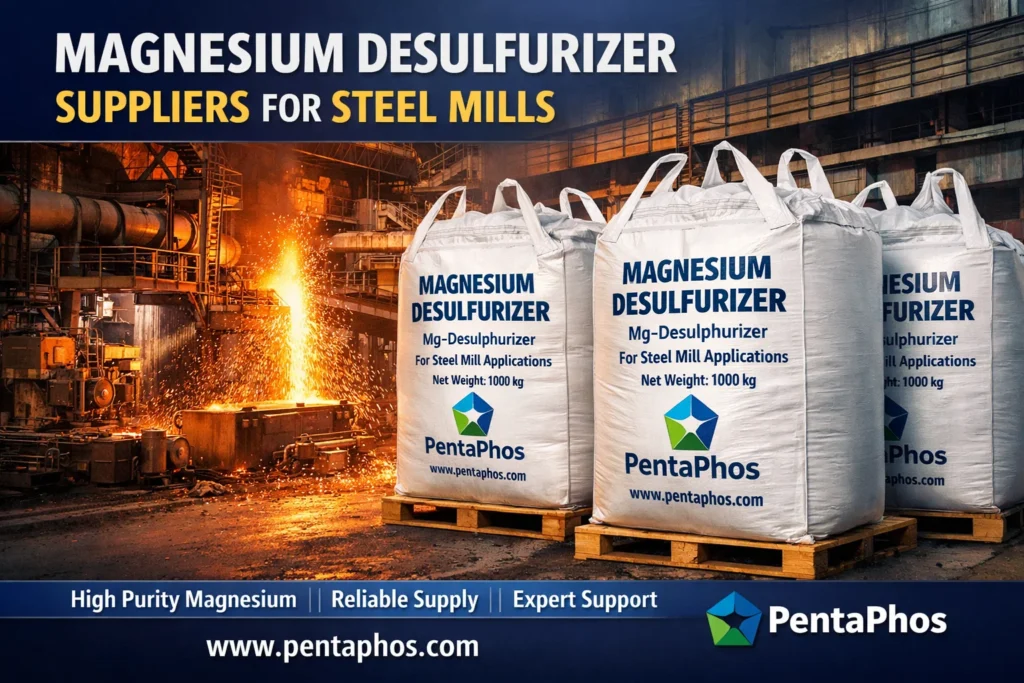
magnesium desulfurizer suppliers for steel mills
Blog

Complete Guide to Magnesium Desulfurizer Suppliers for Steel Mills — Quality, Prices & Buying Guide | Pentaphos

In the steel industry, desulfurization is a key metallurgical process that ensures high-quality steel with improved mechanical properties, reduced brittleness, and enhanced weldability. Magnesium desulfurizer has become one of the most effective additives in this process — and choosing the right magnesium desulfurizer suppliers for steel mills can dramatically impact productivity and product quality. At Pentaphos, we understand the unique demands of steel mill operations. Our premium magnesium desulfurizers are engineered for performance, consistency, and cost-efficiency. This comprehensive guide will help steel producers make informed decisions, comparing suppliers, pricing, benefits, pitfalls, and frequently asked questions. What is Magnesium Desulfurizer & Why It Matters to Steel Mills Magnesium desulfurizer is a metallurgical additive used in secondary steelmaking. It reacts with sulfur in molten steel to form magnesium sulfide (MgS), which has a lower density than liquid steel and thus floats to the surface as slag. Removing sulfur is vital because: Simply put, sulfur must be controlled to produce high-grade steel — and magnesium desulfurizer plays a leading role. Why Choosing the Right Magnesium Desulfurizer Supplier Matters Steel mills depend on desulfurizer suppliers for product quality, delivery timelines, technical support, and cost management. An unreliable supplier can lead to: ✔ Production delays✔ Inconsistent desulfurization results✔ Higher manufacturing costs✔ Poor final product quality Therefore, finding trustworthy magnesium desulfurizer suppliers for steel mills is not just about price — it’s about performance, reliability, and partnership. Pentaphos: Trusted Magnesium Desulfurizer Supplier for Steel Mills At Pentaphos, our magnesium desulfurizers are known for: We cater to steel manufacturers of all scales — from mini mills to integrated steel plants — offering customized packaging, logistics support, and technical guidance. How Magnesium Desulfurization Works — Simple Explained Understanding the science helps mills optimize chemical dosing and reduce waste: Key Factors to Evaluate in Magnesium Desulfurizer Suppliers When comparing suppliers, steel mills should look at: 1. Purity & Composition High Mg content and low impurities ensures fast and efficient reactions. 2. Particle Size & Reactivity Fine and uniform particle sizes increase reaction rates. 3. Consistency Every batch must meet defined quality standards. 4. Technical Documentation MSDS, certificates, and test reports should be readily available. 5. Logistics & Delivery Timely delivery, proper packaging, and stable supply are critical. 6. Cost Efficiency Price per ton, shipping cost, and availability reflect total procurement cost. Top Magnesium Desulfurizer Products by Pentaphos Product Variant Mg Content Granule Size Ideal For Packaging Pentaphos MG-1 90% Min 1–4 mm Basic Steel Mills 25kg Bag Pentaphos MG-2 92% Min 2–5 mm Mid-Range Furnaces 25kg Bag Pentaphos MG-3 95% Min 3–6 mm High-Performance Mills Jumbo Bag Each product is engineered for specific production needs, helping mills optimize costs and performance. Price Table — Magnesium Desulfurizer for Steel Mills Note: Prices vary by quantity, destination, and contract terms. Figures below are indicative and can be tailored on request. Product Price (Per Metric Ton) MOQ Delivery Lead Time Pentaphos MG-1 $750 – $850 5 MT 2–4 weeks Pentaphos MG-2 $850 – $950 5 MT 2–4 weeks Pentaphos MG-3 $950 – $1100 5 MT 3–5 weeks Custom Blends Contact for Quote 10 MT Depends on Specs Bulk orders and long-term supply contracts may qualify for discounts. Pros & Cons of Magnesium Desulfurizer in Steel Mills Pros Cons Efficient sulfur removal Slightly higher cost than lime/other additives Improved steel quality Requires controlled dosing Produces cleaner slag Storage must avoid moisture Reduces defects & re-work Handling safety protocols required Enhances weldability Technical expertise needed for best results How to Choose the Best Supplier — Buying Checklist Before selecting a magnesium desulfurizer supplier, ensure they offer: ✔ Verified quality test reports✔ Transparent pricing & freight terms✔ Reliable production capacity✔ Responsive customer support✔ Compliance with global safety standards✔ Customization ability for specific steel grades Partnering with a supplier like Pentaphos ensures: Magnesium Desulfurizer vs Other Desulfurization Methods Parameter Magnesium Desulfurizer Calcium/Sodium-Based Efficiency High Medium Reaction Speed Fast Moderate End Product Purity High Lower Operating Cost Moderate Lower Heat Stability High Variable While alternatives exist, magnesium desulfurizer stands out in producing low-sulfur steels, essential for critical applications like automotive, pipeline, and high-strength structural steel. Common Applications in Steel Mills Magnesium desulfurizer is widely used in: 🔹 Electric Arc Furnaces (EAF)🔹 Basic Oxygen Furnaces (BOF)🔹 Ladle Metallurgy Processes🔹 Vacuum Degassing Systems🔹 Continuous Casting Applications Safety & Handling Guidelines Magnesium desulfurizer is generally safe when handled properly. Best practices include: ✔ Store in dry, well-ventilated area✔ Avoid moisture contact✔ Use protective gear (gloves, mask, goggles)✔ Train operators on safe dosing methods✔ Comply with MSDS instructions How Pentaphos Supports Steel Mills Beyond Supply At Pentaphos, we go beyond just delivery: 1. Technical Consultation Our experts help you choose the optimal desulfurizer grade based on: 2. Quality Compliance We ensure products are tested and conform to industry standards. 3. Logistics Solutions Timely delivery through our global distribution network. 4. Ongoing Partnership Long-term contracts, forecasting support, and inventory planning help mills stay agile. Case Study: Steel Mill Improves Quality With Pentaphos MG-3 Client: Medium-scale steel producerChallenge: Inconsistent sulfur levels, high rejectionsSolution: Switched to Pentaphos MG-3 with tailored dosingOutcome:✔ Sulfur levels dropped to ≤ 0.015%✔ Reduced rework by 18%✔ Improved weld quality✔ Return on investment within 3 months Frequently Asked Questions (FAQs) Q1. What are typical sulfur targets after using magnesium desulfurizer? Most steel mills aim for ≤ 0.02% sulfur, though special applications may demand even lower levels. Q2. How much magnesium desulfurizer is required per ton of steel? Dosing depends on baseline sulfur, steel grade, and process. Typical ranges are 3–10 kg per ton of liquid steel. Q3. Can magnesium desulfurizer be mixed with other fluxes? Yes — but blend ratios must be carefully calculated to prevent unwanted reactions. Pentaphos can provide mix guidance. Q4. Does magnesium desulfurizer affect other elements? When properly dosed, it reacts primarily with sulfur. Excessive dosing may impact oxygen or phosphorus levels, so technical supervision is vital. Q5. How should magnesium desulfurizer be stored? Keep it in a dry, cool, moisture-free environment. Seal open bags to avoid moisture pickup and caking. Q6. How long does
Magnesium Metal Powder in India
Blog

Magnesium Metal Powder in India: Ultimate Guide to Specifications, Applications & Buying

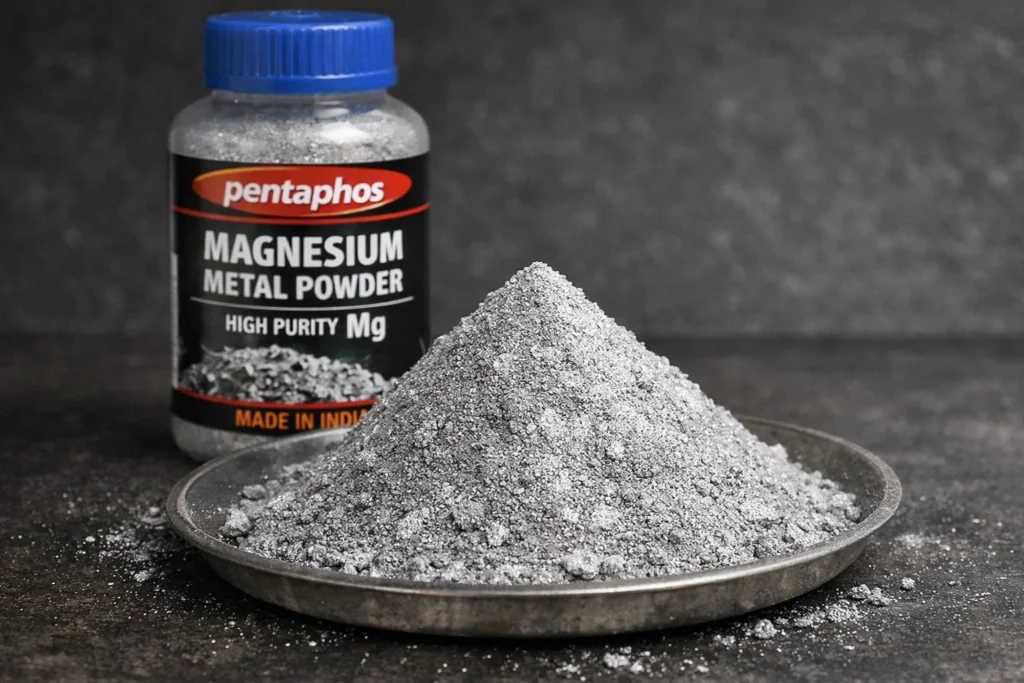
In the world of advanced materials and high-energy chemistry, Magnesium Metal Powder represents the pinnacle of reactivity and versatility. With India’s manufacturing and defense sectors experiencing unprecedented growth, the demand for specialized, high-purity magnesium powder has surged. Whether it’s for aerospace components, sophisticated pyrotechnics, or cutting-edge chemical synthesis, selecting the right magnesium powder is critical to success. This comprehensive guide provides everything you need to know about buying magnesium metal powder in India, from technical specifications to supplier evaluation, with expert insights from Pentaphos.com, a premier manufacturer and supplier. What is Magnesium Metal Powder? Beyond Basic Dust Magnesium powder isn’t merely “ground-up metal.” It’s an engineered material with carefully controlled characteristics that determine its performance in specific applications. Unlike granules, powder offers maximum surface area, resulting in faster reaction rates and more complete combustion—properties essential for many advanced applications. Critical Powder Characteristics: Manufacturing Processes: How Premium Powder is Made At Pentaphos, we employ multiple advanced techniques to produce powder with precise characteristics: 1. Atomization Process (For Spherical Powder) 2. Mechanical Milling (For Irregular/Flake Powder) 3. Electrolytic Process (Ultra-High Purity) Classification & Grades: Choosing the Right Powder Grade Classification Particle Size Range Mesh Equivalent Primary Applications Key Characteristics Coarse Powder 150 – 500 microns 100 – 30 mesh Metallurgical alloying, certain chemical processes Lower reactivity, safer handling, good flowability Medium Powder 45 – 150 microns 325 – 100 mesh General pyrotechnics, standard chemical reagents Balanced reactivity and handling Fine Powder 10 – 45 microns – Advanced pyrotechnics, specialty chemicals, rocket fuels High reactivity, requires special handling Ultra-Fine Powder < 10 microns – Military applications, advanced materials, research Extremely high reactivity, specialized applications only Spherical Powder 15 – 150 microns – Additive manufacturing (3D printing), MIM, thermal spray Excellent flowability, high density, uniform size Flake Powder Variable thickness – Paints, coatings, conductive composites High surface area, platelet structure Applications: Where Magnesium Powder Powers Innovation 1. Defense & Aerospace (Stringently Controlled) 2. Automotive Safety Systems 3. Chemical & Pharmaceutical Industry 4. Metallurgy & Materials Science 5. Pyrotechnics & Entertainment 6. Environmental & Energy Applications Price Chart: Magnesium Metal Powder in India (2024) Grade Specification Purity Particle Size Morphology Price Range (₹ per Kg) MOQ Special Handling Industrial Coarse 99.0% Min 150-500 µm Irregular ₹ 300 – ₹ 380 100 kg Standard Standard Fine 99.5% Min 45-150 µm Irregular ₹ 420 – ₹ 520 50 kg Class D Hazard Premium Fine 99.8% Min 45-150 µm Irregular ₹ 550 – ₹ 680 25 kg Class D Hazard Ultra-Fine 99.8% Min <45 µm Irregular ₹ 850 – ₹ 1,100 10 kg Explosive Atmosphere Spherical (AM Grade) 99.9% Min 15-45 µm Spherical ₹ 2,500 – ₹ 3,500 5 kg Inert Gas Packing Flake Powder 99.5% Min 5-25 µm thick Flake ₹ 900 – ₹ 1,200 20 kg Special Packaging Research Grade 99.99% Min Custom Custom ₹ 4,000 – ₹ 8,000+ 1 kg Ultra-clean Handling Prices are EXW and vary based on quantity, packaging, and market conditions. All prices exclude applicable taxes and hazardous material shipping charges. Safety First: Critical Handling Protocols Magnesium powder is classified as a Class 4.1 Flammable Solid and is DANGEROUS. Essential Safety Measures: Pentaphos Safety Commitment: Quality Parameters: What to Test When Buying When evaluating magnesium metal powder suppliers in India, insist on these test certificates: Mandatory Tests: Pentaphos Quality Assurance: Pros and Cons: Magnesium Powder vs. Other Forms Advantages of Powder Form: Disadvantages & Challenges: How to Select a Reliable Supplier in India Red Flags to Avoid: Why Choose Pentaphos? Step-by-Step Buying GuideDefine Your Requirements:Primary applicationRequired purity levelParticle size specificationsMonthly/annual consumption estimateRequest Quotations: Contact 2-3 reputable suppliers including PentaphosEvaluate Samples: Test powder in your actual processReview Documentation: Check SDS, CoA, and quality certificationsAssess Safety Compatibility: Ensure your facility can handle the material safelyStart with Trial Order: Before committing to large volumesEstablish Quality Checks: Define acceptance criteria for incoming materialReview Performance: After initial use, assess if specifications need adjustment Frequently Asked Questions (FAQ) Q1: What is the difference between magnesium powder and magnesium grit/dust?A: Powder refers to material intentionally manufactured to specific size ranges. Grit or dust is often a byproduct of machining and has uncontrolled size distribution and possible contamination. Q2: Can we import magnesium powder, or is it better to buy domestically?A: While import is possible, it involves complex hazardous material logistics, import duties, and long lead times. Domestic suppliers like Pentaphos offer better support, faster delivery, and understanding of local regulations. Q3: What is the shelf life of magnesium powder?A: When stored properly in sealed, moisture-proof containers under inert gas, our powder maintains specifications for 12-18 months. Fine and ultra-fine grades have shorter optimal shelf life (8-12 months). Q4: Do you offer custom particle size distributions?A: Yes, we can produce powder to your specific size distribution requirements (within safety limits) with minimum order quantities. This is common for specialized applications. Q5: How is magnesium powder shipped within India?A: We ship via road transport using DGTA-certified carriers. Packaging meets UN specifications. We handle all necessary documentation and comply with the Explosives Act and Hazardous Material transportation rules. Q6: Can you supply powder for defense applications?A: Yes, we are an approved supplier to several defense units and follow all necessary security protocols, documentation, and quality standards required for defense applications. Q7: What is the minimum order quantity for experimental/research purposes?A: We offer research quantities starting from 1 kg for genuine R&D institutions, with proper documentation of intended use. Q8: How do I know if I need spherical vs. irregular powder?A: Spherical powder flows better and packs more densely—ideal for additive manufacturing and filling molds. Irregular powder has higher surface area—better for chemical reactions and pyrotechnics. Our technical team can guide you. Q9: What certifications does Pentaphos hold for powder manufacturing?A: We are ISO 9001:2015 certified, comply with ISO 80079-34 for explosive atmosphere equipment, and follow guidelines of the Petroleum and Explosives Safety Organization (PESO) for applicable products. Q10: Do you provide technical support for application development?A: Absolutely. Our R&D team works with customers to develop or optimize formulations, troubleshoot issues, and

Magnesium Ingots in India
Blog

Magnesium Ingots in India: The Ultimate Guide to Procurement, Specifications & Applications

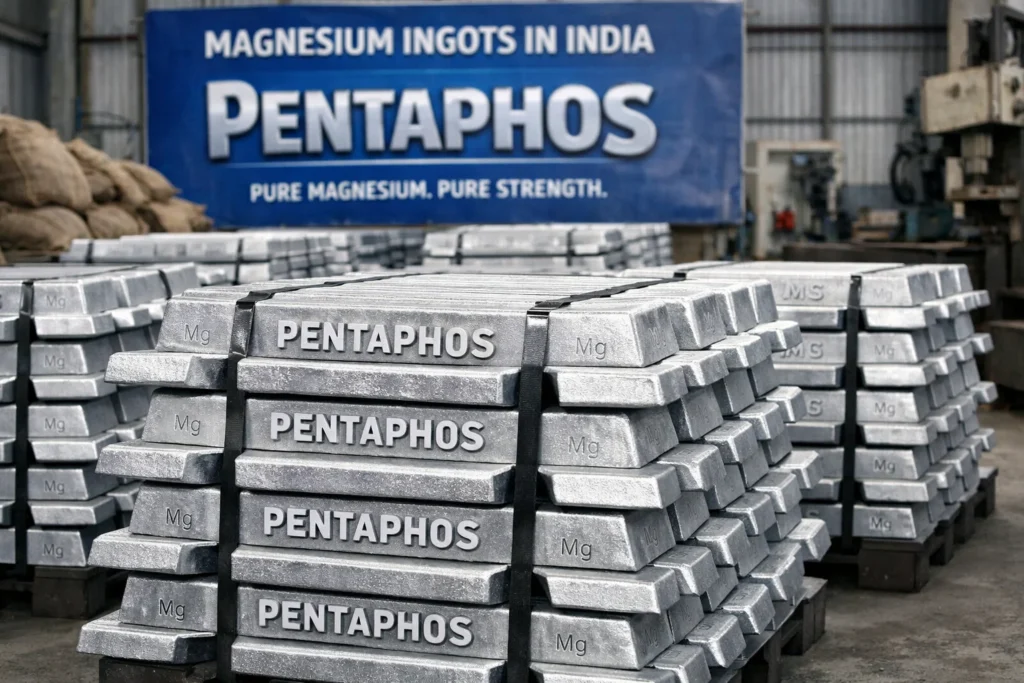
In the hierarchy of magnesium products, Magnesium Ingots represent the primal, elemental form—the building block from which all other magnesium products are derived. As India’s manufacturing sector expands across automotive, aerospace, metallurgy, and chemical industries, the strategic procurement of high-quality magnesium ingots has become a critical concern for procurement managers and production heads. Unlike processed forms like granules or powder, ingots offer stability, cost-effectiveness, and versatility for various downstream applications. This definitive guide provides comprehensive insights into purchasing magnesium ingots in India, covering everything from international standards to pricing dynamics, with expert perspective from Pentaphos.com, a leading supplier to India’s core industries. Whether you’re an alloy producer, chemical manufacturer, or metal trader, understanding the ingot market is essential for competitive advantage. Understanding Magnesium Ingots: More Than Just Metal Blocks Magnesium ingots are solidified blocks of pure or alloyed magnesium, typically produced via electrolytic or thermal reduction processes. They serve as the primary raw material for: Physical Characteristics: Global Classification Systems: Understanding What You’re Buying 1. ASTM Standards (Most Common in India) 2. Chinese Standards (GB/T) 3. European Standards (EN) 4. Indian Standards (IS) Pentaphos Supply Grades: Meeting Diverse Industrial Needs Grade Designation Mg Purity (%) Min Key Impurity Limits (Max) Primary Applications Form Availability Industrial Pure (IP) 99.80 Fe: 0.05%, Si: 0.05%, Cu: 0.02% Desulphurization, alloying, chemical processes 7.5kg ingots, 1MT bundles High Purity (HP) 99.90 Fe: 0.04%, Si: 0.03%, Ni: 0.001% Aerospace alloys, high-grade chemical synthesis 7.5kg ingots, vacuum packed Ultra High Purity (UHP) 99.95 Fe: 0.003%, Cu: 0.002%, Ni: 0.0005% Electronics, special alloys, research 5kg/10kg ingots, argon packed Alloy Grade (AZ91D) Mg base (~90%) Al: 9%, Zn: 0.7%, Mn: 0.3% Die-casting for automotive components 10kg notched ingots Sacrificial Anode Grade 99.80 Specific Mn content, controlled Fe:Mn ratio Cathodic protection systems 10kg/15kg trapezoidal Manufacturing Processes: From Ore to Ingot 1. Pidgeon Process (Silico-thermal Reduction) 2. Electrolytic Process 3. Indian Production Context Applications: Where Magnesium Ingots Create Value 1. Aluminum Alloying (Largest Application – 40-50% of global use) 2. Die-Casting Alloys 3. Steel Industry – Desulphurization 4. Chemical & Reduction Agent 5. Cathodic Protection 6. Other Metallurgical Uses Market Dynamics & Price Chart (2024) Factors Influencing Magnesium Ingot Prices in India: Price Chart: Magnesium Ingots in India (2024) Grade Purity Form Quantity Price Range (₹/Kg) Delivery Terms Lead Time Standard IP Grade 99.8% Min 7.5kg Ingots 1-5 MT ₹ 210 – ₹ 260 Ex-Works 3-5 days Standard IP Grade 99.8% Min 7.5kg Ingots 5-20 MT ₹ 200 – ₹ 250 FOR Plant 5-7 days Standard IP Grade 99.8% Min 1MT Bundles 20+ MT ₹ 195 – ₹ 240 FOR Plant 7-10 days High Purity (HP) 99.9% Min 7.5kg Ingots 1-10 MT ₹ 270 – ₹ 320 Ex-Works 7-10 days Ultra High Purity 99.95% Min Vacuum Packed 500kg+ ₹ 350 – ₹ 450 Ex-Works 14-21 days Alloy Grade AZ91D As per spec 10kg Notched 5MT+ ₹ 240 – ₹ 290 FOR Plant 10-15 days Anode Grade 99.8% with Mn 15kg Ingots 2MT+ ₹ 225 – ₹ 275 FOR Plant 7-10 days Price Components Breakdown (Example for 1 MT IP Grade @ ₹220/kg): Note: Prices are indicative and fluctuate daily. Contact Pentaphos for live pricing. Minimum order quantity varies by grade. Quality Assurance: What to Verify When Purchasing Essential Documentation:Material Test Certificate (MTC) – Must include:Chemical composition (spectrographic analysis)Batch/Heat numberManufacturer detailsDate of manufactureCertificate of Origin – For imported materialSafety Data Sheet (SDS) – For safe handling and storageMill Certificate – From primary producer (for traceability)Physical Inspection Checklist:Visual Examination:Clean surface with minimal oxidationNo visible slag inclusions or contaminantsProper shape and weight consistencyLegible markingsSampling & Testing (Recommended for bulk orders):Drill samples from random ingots (top, middle, bottom)Independent lab analysis for critical applicationsVerify against MTC specificationsWeight Verification:Random weighing of ingotsTolerance typically ±0.5kg per 7.5kg ingotStorage & Handling Best PracticesStorage Conditions:Location: Dry, well-ventilated warehouseStacking: On wooden pallets, away from wallsSeparation: From acids, chlorides, and oxidizing agentsHeight Limit: Maximum 2 meters for safetyFirst-In-First-Out: Rotate stock to prevent long-term storageHandling Safety:Personal Protective Equipment (PPE): Safety glasses, gloves, steel-toe bootsFire Safety: Keep Class D extinguishers accessible (never use water)Ventilation: Ensure adequate ventilation in storage areasSpill Management: Collect chips/turnings in covered metal containersPentaphos Packaging Standards:Standard: 40 ingots per wooden crate (300kg)Bulk: 1MT bundles with steel strappingPremium Grades: Vacuum-sealed or argon-flushed packagingLabeling: Clear markings with grade, batch, weight, and safety symbolsPros and Cons of Different Procurement StrategiesOption 1: Import Directly from Primary ProducersPros:Potentially lower base priceDirect relationship with manufacturerAccess to wider grade selectionCons:High minimum order quantities (20-40 MT containers)Long lead times (45-60 days)Currency exchange riskQuality dispute resolution difficultiesComplex logistics and customs clearanceImport duties and taxes (~10-15% additional cost)Option 2: Purchase from Domestic Stockists/SuppliersPros:Smaller MOQs (1 MT and above)Faster delivery (within days)Local support and technical assistanceQuality verification before purchaseNo customs complexitiesEstablished dispute resolutionCons:Margin added by supplierLimited grade availability sometimesOption 3: Partner with Specialized Supplier like PentaphosAdvantages:Hybrid Model: Benefits of both domestic and international sourcingGrade Availability: Wide range from stock or on-orderTechnical Support: Application-specific guidanceQuality Assurance: Pre-verified material with traceabilityFlexible Quantities: From 500kg to full container loadsMarket Intelligence: Price trend advice and hedging optionsValue-added Services: Cutting, sampling, just-in-time deliverySupply Chain Considerations for Indian BuyersCurrent Market Structure:Primary Producers: Limited in India, mainly imports from China, Israel, USA, RussiaAuthorized Distributors: Like Pentaphos with long-term contractsTraders: Smaller operators with fluctuating stockEnd Users: Automakers, alloy producers, chemical companiesStrategic Recommendations:Dual Sourcing: Maintain relationships with at least two reliable suppliersInventory Strategy: Balance between holding costs and price volatilityForward Contracts: For predictable consumption patternsQuality Consistency: Prioritize over marginal price differencesGeographic Spread: Consider regional stockists for reduced logistics time Frequently Asked Questions (FAQ) Q1: What is the difference between primary and secondary magnesium ingots?A: Primary ingots are produced directly from ore/brine. Secondary ingots are from recycled scrap. Primary has more controlled chemistry; secondary may have higher impurity levels but is more economical for some applications. Q2: Why do ingot prices fluctuate so much?A: Magnesium production is energy-intensive (14-16 MWh/ton), so energy prices directly impact costs. Chinese production (85% of global supply) is sensitive to environmental policies, power tariffs, and export regulations, causing volatility. Q3: What are the payment terms typically

Pharma-Grade Magnesium Powder
Blog

Pharma-Grade Magnesium Powder: The Ultimate Guide to Sourcing, Specifications & Compliance in India

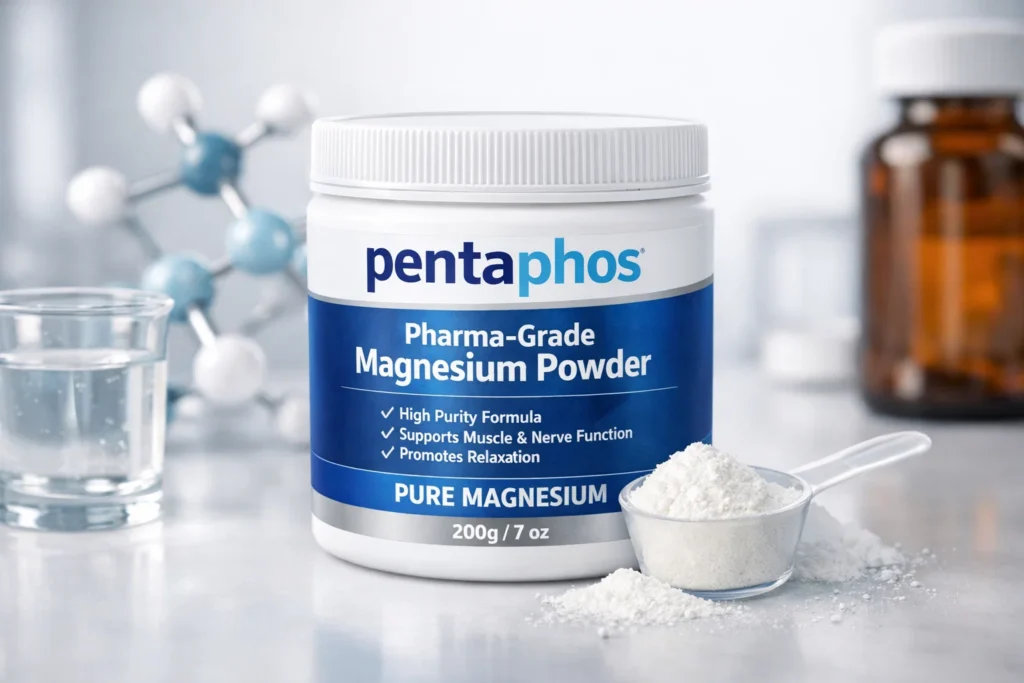
In the meticulously regulated world of pharmaceutical manufacturing, where purity isn’t just a preference but an absolute mandate, Pharma-Grade Magnesium Powder stands as a specialized material of immense importance. Unlike industrial magnesium, pharma-grade material must meet extraordinarily stringent standards for purity, trace element control, and documentation. As India solidifies its position as the “Pharmacy of the World,” the demand for certified, compliant magnesium powder for Active Pharmaceutical Ingredient (API) manufacturing, excipients, and synthesis has surged dramatically. This comprehensive guide is designed specifically for pharmaceutical companies, CROs, research institutions, and API manufacturers seeking reliable Pharma-Grade Magnesium Powder Suppliers in India. We delve deep into the specifications that matter, the regulatory landscape, and how to identify genuine suppliers, with insights from Pentaphos.com, a trusted partner to India’s pharmaceutical industry. Understanding Pharma-Grade vs. Industrial-Grade: A Critical Distinction Industrial-Grade Magnesium Powder: Pharma-Grade Magnesium Powder: Key Specifications for Pharma-Grade Magnesium Powder 1. Chemical Purity (USP/EP/JP Standards) 2. Physical Characteristics In the meticulously regulated world of pharmaceutical manufacturing, where purity isn’t just a preference but an absolute mandate, Pharma-Grade Magnesium Powder stands as a specialized material of immense importance. Unlike industrial magnesium, pharma-grade material must meet extraordinarily stringent standards for purity, trace element control, and documentation. As India solidifies its position as the “Pharmacy of the World,” the demand for certified, compliant magnesium powder for Active Pharmaceutical Ingredient (API) manufacturing, excipients, and synthesis has surged dramatically. This comprehensive guide is designed specifically for pharmaceutical companies, CROs, research institutions, and API manufacturers seeking reliable Pharma-Grade Magnesium Powder Suppliers in India. We delve deep into the specifications that matter, the regulatory landscape, and how to identify genuine suppliers, with insights from Pentaphos.com, a trusted partner to India’s pharmaceutical industry. Understanding Pharma-Grade vs. Industrial-Grade: A Critical Distinction Industrial-Grade Magnesium Powder: Pharma-Grade Magnesium Powder: Key Specifications for Pharma-Grade Magnesium Powder 1. Chemical Purity (USP/EP/JP Standards) 2. Physical Characteristics Regulatory Compliance: Navigating the Pharmaceutical Landscape Essential Certifications & Documentation: Audit Readiness: A genuine pharma-grade supplier should be: Applications in Pharmaceutical Manufacturing 1. Grignard Reagent Synthesis (Most Significant Application) 2. API Manufacturing Intermediate 3. Nutritional Supplements 4. Pharmaceutical Excipients 5. Research & Development Sourcing Strategy: How to Select a Reliable Supplier Red Flags to Watch For: Essential Supplier Evaluation Criteria: Pentaphos Pharma-Grade Magnesium Powder: Our Commitment Our Product Range: Grade Purity Particle Size (D90) Primary Use Packaging Shelf Life PG-Mg-100 99.9% Min <150 μm General Grignard, API synthesis 5kg HDPE drums 24 months PG-Mg-200 99.95% Min <75 μm Fine chemical synthesis 2kg double bagged 18 months PG-Mg-325 99.95% Min <45 μm High-reactivity applications 1kg aluminized bags 12 months PG-Mg-HP 99.98% Min Custom Critical applications, injectables Custom 12 months PG-Mg-LOD 99.9% Min <150 μm Low moisture (<0.1%) Nitrogen flushed 24 months Our Quality Assurance Protocol: Price Structure: Understanding the Premium Pharma-Grade Magnesium Powder Price Chart (2026) Grade Purity Quantity Price Range (₹/Kg) Key Differentiator Industrial Fine 99.5% 50kg+ ₹ 400 – ₹ 500 Basic chemical grade PG-Mg-100 99.9% 25kg+ ₹ 1,200 – ₹ 1,500 Full pharmacopoeial testing PG-Mg-200 99.95% 10kg+ ₹ 1,800 – ₹ 2,200 Lower heavy metals, finer size PG-Mg-325 99.95% 5kg+ ₹ 2,500 – ₹ 3,000 Ultra-fine, high reactivity PG-Mg-HP 99.98% 1kg+ ₹ 4,000 – ₹ 6,000 Injectables grade, complete characterization Custom Grade Custom Custom ₹ 3,000 – ₹ 10,000+ Specific particle engineering, special packaging Price Justification: The premium covers: Storage & Handling: Maintaining Integrity Critical Parameters: Pentaphos Packaging Standards: Technical Support: Beyond Supply What to Expect from a Quality Supplier: Pentaphos Value-Added Services: Frequently Asked Questions (FAQ) Q1: What pharmacopoeial standards do you comply with?A: Our products are tested against USP, EP, and JP monographs for Magnesium. We can tailor testing to your specific pharmacopoeia requirements. Q2: Can you supply material with DMF/EDMF?A: Yes, we have a Type II DMF for our manufacturing process and can provide a Letter of Authorization (LOA) to support your regulatory filings. Q3: What is your lead time for pharma-grade powder?A: Standard grades: 7-10 days from order. Custom specifications: 4-6 weeks. Emergency orders: We maintain limited stock for urgent requirements. Q4: How do you handle change control and notifications?A: We have a formal change control procedure. Any change in process, equipment, or specifications is communicated to customers in advance with justification and supporting data. Q5: Can you supply material for injectable applications?A: Yes, we have an ultra-high purity grade suitable for injectables after further processing. It includes additional testing for bacterial endotoxins (<0.25 EU/mg) and sterility. Q6: What is your approach to elemental impurities (ICH Q3D)?A: We perform full elemental impurity profiling using ICP-MS and ensure compliance with ICH Q3D Option 1 (product-specific testing) limits. Q7: Do you offer material with specific particle engineering?A: Yes, we can customize particle size distribution, morphology, and surface characteristics to optimize performance in your specific process. Q8: How do you ensure microbiological quality?A: Through controlled manufacturing environment, purified water for washing (if needed), and gamma irradiation option for specific applications. Q9: What is your batch size range?A: We can produce from 1kg development batches to 100kg production batches with consistency. Q10: Are you open to customer audits?A: Absolutely. We welcome and regularly host customer and regulatory audits. We are proud of our facilities and quality systems.

Bulk Magnesium Alloy Supplier in India
Blog

Bulk Magnesium Alloy Supplier in India: Comprehensive Guide to Procurement, Specifications & Applications

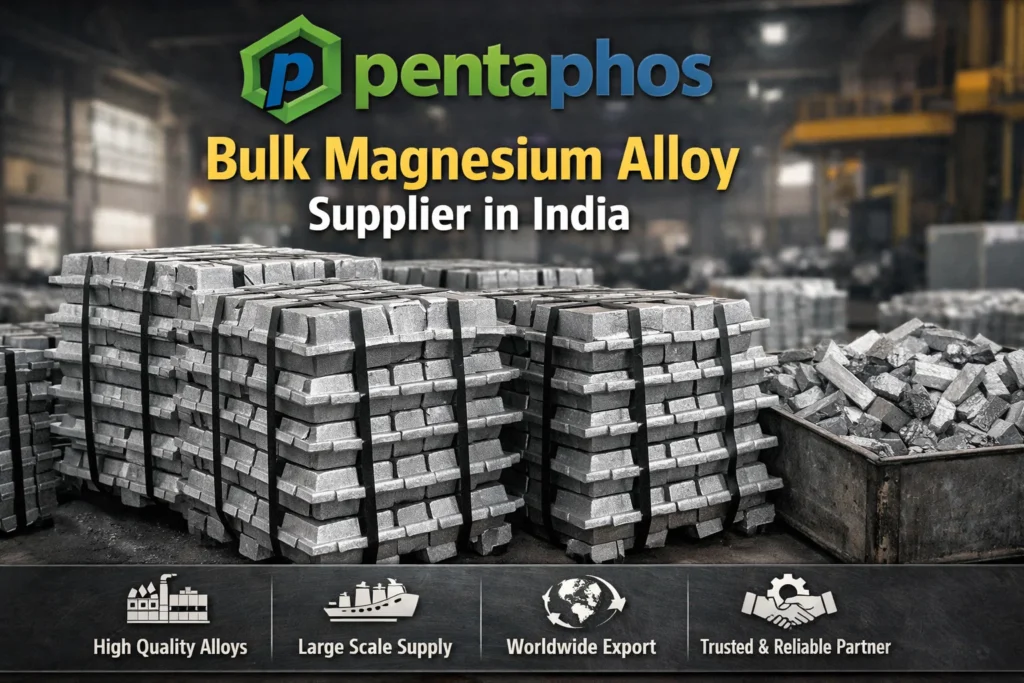
In the relentless pursuit of lightweighting across automotive, aerospace, electronics, and defense sectors, magnesium alloys have emerged as the material of strategic importance. With an impressive strength-to-weight ratio (35% lighter than aluminum, 78% lighter than steel), excellent damping capacity, and good machinability, magnesium alloys are revolutionizing product design. However, the challenge for Indian manufacturers lies in finding a reliable Bulk Magnesium Alloy Supplier in India who can provide consistent quality, technical expertise, and supply chain reliability at competitive prices. This exhaustive guide explores the complex world of magnesium alloys, providing Indian manufacturers with the knowledge needed to make informed procurement decisions. We’ll cover everything from alloy classification and specifications to market dynamics and supplier evaluation, with specialized insights from Pentaphos.com, a premier supplier to India’s engineering and manufacturing sectors. Understanding Magnesium Alloys: More Than Just Light Weight Why Alloying is Essential: Pure magnesium, while lightweight, has limited mechanical properties for engineering applications. Alloying with aluminum, zinc, manganese, rare earths, and other elements enhances: Key Alloying Elements and Their Effects: Element Typical Range (%) Primary Effects Trade-offs Aluminum (Al) 3-9% ↑ Strength, ↑ Castability, ↑ Fluidity ↓ Ductility at >6%, ↑ Micro-porosity Zinc (Zn) 0.5-2% ↑ Strength, ↑ Corrosion resistance >3% causes micro-shrinkage, hot cracking Manganese (Mn) 0.15-0.5% ↑ Corrosion resistance, ↑ Yield strength Forms compounds with Fe, removing it from solid solution Rare Earths (RE) 0.5-4% ↑ Creep resistance, ↑ High-temp strength Significant cost increase, ↓ Ductility Zirconium (Zr) 0.4-0.8% Grain refinement, ↑ Strength, ↑ Corrosion resistance Difficult to add, requires special techniques Silicon (Si) 0.5-1.5% ↑ Fluidity, ↓ Hot tearing Forms brittle Mg₂Si phase Calcium (Ca) 0.1-2% ↑ Creep resistance, ↓ Oxidation during melting Can cause casting defects if not controlled Major Magnesium Alloy Systems and Their Applications 1. AZ Series (Aluminum-Zinc) – Most CommonAZ91D (9% Al, 0.7% Zn, 0.2% Mn): The “workhorse” alloyApplications: Automotive components (transmission cases, steering wheels), electronics housings, power toolsProperties: Good strength, excellent castability, moderate corrosion resistanceForm: Die casting (90% of usage), also sand casting, permanent moldAZ31B (3% Al, 1% Zn, 0.2% Mn): Premier wrought alloyApplications: Aerospace components, laptop cases, automotive panelsProperties: Good formability, moderate strength, weldableForm: Sheet, plate, extrusions2. AM Series (Aluminum-Manganese)AM60B (6% Al, 0.3% Mn): High ductility alloyApplications: Automotive safety components (seat frames, steering columns)Properties: Excellent impact strength, good elongation (10-15%)Form: Primarily die casting3. AS Series (Aluminum-Silicon)AS41B (4% Al, 1% Si, 0.3% Mn): High temperature alloyApplications: Engine blocks, transmission cases (where temperatures exceed 120°C)Properties: Good creep resistance, fluidity4. AE Series (Aluminum-Rare Earth)AE44 (4% Al, 4% RE): Premium high-performance alloyApplications: Aerospace, racing components, high-temp automotive partsProperties: Excellent creep resistance, good castabilityCost: Significantly higher due to RE content5. ZK Series (Zinc-Zirconium)ZK60A (5.5% Zn, 0.5% Zr): High-strength wrought alloyApplications: Aerospace forgings, racing wheels, high-performance componentsProperties: Highest strength of commercial Mg alloys, good fatigue resistanceMarket Landscape: Magnesium Alloy Supply in IndiaCurrent Supply Scenario:Primary Alloy Production: Limited domestic primary production of Mg alloysImports: Majorly from China (80%+), also Israel, USA, RussiaDomestic Recycling: Growing secondary alloy production from scrapSupplier Types:Direct Importers: Large volume importers of primary alloysAlloy Producers: Companies producing from primary Mg and alloying elementsSecondary Producers: Using recycled/scrap materialDistributors/Stockists: Like Pentaphos with mixed sourcing strategyChallenges in the Indian Market:Price Volatility: Linked to international Mg prices and currency fluctuationsQuality Consistency: Variable quality from different sourcesTechnical Support: Limited metallurgical expertise among suppliersLogistics: Import delays, customs clearance issuesMinimum Order Quantities: High MOQs for direct imports (5-20 MT)Pentaphos Bulk Magnesium Alloy Supply StrategyOur Multi-Source Approach:Primary Alloys: Strategic partnerships with certified producersSecondary Alloys: From audited recyclers meeting quality standardsCustom Alloying: In-house or through partners for specific requirementsInventory Management: Strategic stock at multiple locationsAvailable Forms & Specifications:Alloy GradeFormStandard SizePurity/QualityTypely Available QuantityAZ91DIngots10kg notchedPrimary (99.8% base)1 MT to full containerAZ91DIngots10kg notchedSecondary (recycled)500kg and aboveAM60BIngots10kg trapezoidalPrimary2 MT and aboveAS41BIngots10kg standardPrimary1 MT and aboveAZ31BSheet/Plate1-6mm thicknessWrought quality100kg and aboveAZ31BExtrusionsRods, bars, profilesCustom500kg and aboveCustom AlloysVariousAs requiredTo specification500kg minimumTechnical Specifications: What Matters for Quality AssuranceCritical Parameters for Bulk Procurement:Chemical Composition: Must meet ASTM/EN/JIS standards with tight tolerancesGas Content: Hydrogen, oxygen, nitrogen (critical for porosity in castings)Inclusion Level: Oxide, flux, intermetallic inclusionsGrain Size: For wrought products, finer is generally betterMechanical Properties: Yield strength, tensile strength, elongation (for wrought products) Pentaphos Quality Assurance Protocol: Applications Across Industries: The Growing Demand in India 1. Automotive & Transportation (40% of global Mg use) 2. Aerospace & Defense (High-value applications) 3. Electronics & Consumer Goods 4. Industrial & Machinery 5. Medical & Orthopedic Price Structure & Economics of Bulk Procurement Magnesium Alloy Price Chart (2024) – India Market Alloy Grade Form Quantity Price Range (₹/Kg) Key Price Drivers AZ91D (Primary) 10kg Ingots 1-5 MT ₹ 280 – ₹ 340 LME Mg price, Al price, import duties AZ91D (Primary) 10kg Ingots 5-20 MT ₹ 260 – ₹ 320 Volume discount, long-term contracts AZ91D (Secondary) 10kg Ingots 5-20 MT ₹ 230 – ₹ 280 Scrap price, refining cost AM60B 10kg Ingots 2-10 MT ₹ 300 – ₹ 360 Higher processing costs AS41B 10kg Ingots 1-5 MT ₹ 320 – ₹ 380 Silicon addition, smaller market AZ31B Sheet 3mm thickness 100-500kg ₹ 450 – ₹ 550 Rolling costs, yield losses Custom Alloy As specified 500kg-2MT ₹ 350 – ₹ 800+ R&D, small batch, special elements Total Cost of Ownership Considerations: Economic Case Study: Automotive Component Traditional: Aluminum casting – 2.5kg, ₹ 400/kg = ₹ 1,000Mg Alternative: AZ91D casting – 1.5kg (40% lighter), ₹ 320/kg = ₹ 480Direct Material Savings: ₹ 520 (52% reduction)Additional Benefits: Reduced energy in use, better performance, potential for part consolidation Procurement Strategy: How to Source Effectively For Large Volume Users (>5 MT/month): For Medium Volume Users (500kg-5 MT/month): For Small Volume Users (<500kg/month): Supplier Evaluation Checklist Essential Criteria: Red Flags to Avoid:Cannot provide Material Test CertificatesNo understanding of alloy metallurgyPrices significantly below market (may indicate inferior quality)Inconsistent stock availabilityPoor communication and response timesThe Pentaphos Advantage: Why Choose Us as Your Bulk Alloy Supplier1. Technical Metallurgical ExpertiseOn-staff metallurgists with alloy development experienceApplication engineering supportFailure analysis and troubleshooting capability2. Quality AssuranceRigorous incoming material inspectionBatch testing and certificationQuality consistency across orders3. Supply Chain ReliabilityMultiple sourcing partnershipsStrategic inventory at key locationsBackup supply arrangements4. Value-Added ServicesAlloy Selection Guidance: For

Magnesium Desulphurizer for Steel
Blog

Magnesium Desulphurizer for Steel: The Complete Guide to Process, Benefits & Sourcing in India

In the high-stakes world of steel production, where purity defines profitability, Magnesium Desulphurizer stands as a technological marvel that has revolutionized quality control. As India positions itself as a global steel powerhouse—aiming for 300 MT capacity by 2030—the demand for efficient, cost-effective desulphurization has never been higher. Sulfur, often called “the enemy of steel,” can cause hot shortness, reduce weldability, and diminish mechanical properties if not meticulously controlled. This comprehensive guide explores why magnesium has become the desulphurizer of choice for progressive steel plants across India and globally. We’ll delve beyond the basic “role of magnesium” to examine the chemistry, economics, and practical implementation of magnesium-based desulphurization, with insights from Pentaphos.com, a leading supplier to India’s metallurgical industry. The Science Behind Desulphurization: Why Magnesium Works The Sulfur Problem in Steel Sulfur enters the steelmaking process primarily through coke and iron ore. In molten iron, sulfur exists as iron sulfide (FeS), which has high solubility. However, in solid steel, its solubility plummets, causing it to form brittle iron sulfide films at grain boundaries during cooling. This leads to: Magnesium’s Chemical Advantage Magnesium possesses exceptional thermodynamic properties for desulphurization: The Reaction:Mg (l) + S (in Fe) → MgS (s) Key Characteristics: Magnesium’s Chemical Advantage Magnesium possesses exceptional thermodynamic properties for desulphurization: The Reaction:Mg (l) + S (in Fe) → MgS (s) Key Characteristics: 3. Submerged Lance with Cored Magnesium A combination approach offering efficiency between injection and wire feeding. Comparative Analysis: Magnesium vs. Alternative Desulphurizers Parameter Magnesium (Mg) Calcium Carbide (CaC₂) Soda Ash (Na₂CO₃) Lime (CaO) Desulphurization Efficiency Excellent (85-95%) Good (70-85%) Moderate (50-70%) Poor (30-50%) Reaction Speed Very Fast (5-15 min) Moderate (15-25 min) Fast (10-20 min) Slow (20-30 min) Operating Temperature 1250-1450°C 1300-1500°C 1200-1350°C >1450°C Capital Cost Moderate Low Low Very Low Operating Cost Lowest (₹/S removed) High Moderate Very High Environmental Impact Low High (C₂H₂ gas) Moderate (Na fumes) Low Slag Volume Low High High Very High Indian Market Adoption >65% (Growing) Declining Niche Limited Data based on Indian steel plant surveys and Pentaphos customer feedback 3. Submerged Lance with Cored Magnesium A combination approach offering efficiency between injection and wire feeding. Comparative Analysis: Magnesium vs. Alternative Desulphurizers Parameter Magnesium (Mg) Calcium Carbide (CaC₂) Soda Ash (Na₂CO₃) Lime (CaO) Desulphurization Efficiency Excellent (85-95%) Good (70-85%) Moderate (50-70%) Poor (30-50%) Reaction Speed Very Fast (5-15 min) Moderate (15-25 min) Fast (10-20 min) Slow (20-30 min) Operating Temperature 1250-1450°C 1300-1500°C 1200-1350°C >1450°C Capital Cost Moderate Low Low Very Low Operating Cost Lowest (₹/S removed) High Moderate Very High Environmental Impact Low High (C₂H₂ gas) Moderate (Na fumes) Low Slag Volume Low High High Very High Indian Market Adoption >65% (Growing) Declining Niche Limited Data based on Indian steel plant surveys and Pentaphos customer feedback Technical Specifications & Price Chart (2026) Product Type Mg Content Carrier/Additives Recommended Application Price Range (₹/Kg) Typical Dosage (kg/T HM) Pure Mg Granules 99.8% Min None Modern injection systems ₹ 280 – ₹ 350 0.4 – 0.8 Mg-CaO Blend (70:30) 70% ± 2% Burnt Lime General purpose injection ₹ 220 – ₹ 280 0.6 – 1.0 Mg-Dolomite Blend 65% ± 2% Calcined Dolomite High temp operations ₹ 230 – ₹ 290 0.7 – 1.1 Enhanced Yield Mix 75% ± 2% Proprietary catalysts Low Mg recovery systems ₹ 260 – ₹ 320 0.5 – 0.9 Low-Fume Formula 60% ± 2% Fume suppressants Shops with ventilation limits ₹ 250 – ₹ 310 0.8 – 1.2 *HM = Hot Metal. Prices are FOR plant and vary with order quantity, location, and market conditions. Dosage depends on initial S content (typically 0.025-0.06%) and target S (often <0.010%).* Economic Benefits: The Cost-Saving PropositionCase Study: 1 MTPA Integrated Steel PlantBefore Mg Desulphurization:Lime-based treatment: ₹ 180-220 per ton of hot metalSulfur levels: 0.025-0.035%High slag disposal costsRefractory wear: HighAfter Switching to Pentaphos Mg Desulphurizer:Treatment cost: ₹ 120-160 per ton of hot metalSavings: ₹ 40-60 per tonSulfur levels: 0.008-0.015%Annual savings (1 MTPA): ₹ 4-6 CroresAdditional benefits: Reduced slag (30-40% less), longer refractory life, better steel quality premiumsPros and Cons of Magnesium DesulphurizationAdvantages:Highest Efficiency: Achieves ultra-low sulfur levels (<0.005% possible)Speed: Short treatment times increase ladle turnoverCost-Effective: Lowest cost per unit sulfur removedClean Process: Minimal fuming with modern formulationsFlexibility: Suitable for various hot metal conditionsImproved Steel Quality: Enables production of high-grade, defect-free steelChallenges & Solutions:Magnesium Fuming:Challenge: Vaporization can cause violent reactionPentaphos Solution: Our coated granules and proprietary blends ensure controlled releaseSafety Concerns:Challenge: Mg is flammable in powder formPentaphos Solution: We supply granules (not powder) with proper MSDS and safety trainingInitial Capital Cost:Challenge: Injection systems require investmentPentaphos Solution: We provide ROI analysis and can recommend phased implementation Implementation Guide for Steel Plants For Plants Considering Adoption: Optimization for Existing Users: Frequently Asked Questions (FAQ) Q1: What sulfur reduction can we realistically expect with magnesium desulphurization?A: With proper implementation, you can consistently achieve 85-95% sulfur removal. Starting with 0.030% S, final levels of 0.003-0.008% are regularly achieved by our customers. Q2: How does temperature affect magnesium desulphurization efficiency?A: Magnesium works effectively across standard hot metal temperatures (1250-1450°C). Our different formulations are optimized for specific ranges—we recommend the appropriate grade based on your operating temperature. Q3: Is magnesium desulphurization suitable for mini-steel plants with induction furnaces?A: Absolutely. While initially developed for integrated plants, magnesium-based treatments have been successfully adapted for smaller EAF and induction furnace operations with proper equipment modifications. Q4: What safety precautions are necessary when handling magnesium desulphurizer?A: Store in dry conditions away from acids and oxidizers. Use non-sparking tools. Ensure proper ventilation during addition. We provide complete safety protocols and on-site training. Q5: Can we use magnesium desulphurizer in ladles with basic lining?A: Yes, magnesium is compatible with both basic and dolomite linings. In fact, it often extends lining life compared to lime-based treatments which generate more slag. Q6: How does Pentaphos ensure consistent quality in magnesium desulphurizers?A: Every batch undergoes: 1) Chemical assay for Mg%, 2) Size analysis for injection characteristics, 3) Reactivity testing, 4) Moisture content verification. Batch-wise certificates are provided. Q7: What is the shelf life of your magnesium desulphurizer products?A: When stored properly

Magnesium Granules Manufacturer & Supplier in India
Blog

Magnesium Granules Manufacturer & Supplier in India: A Complete Buyer’s Guide

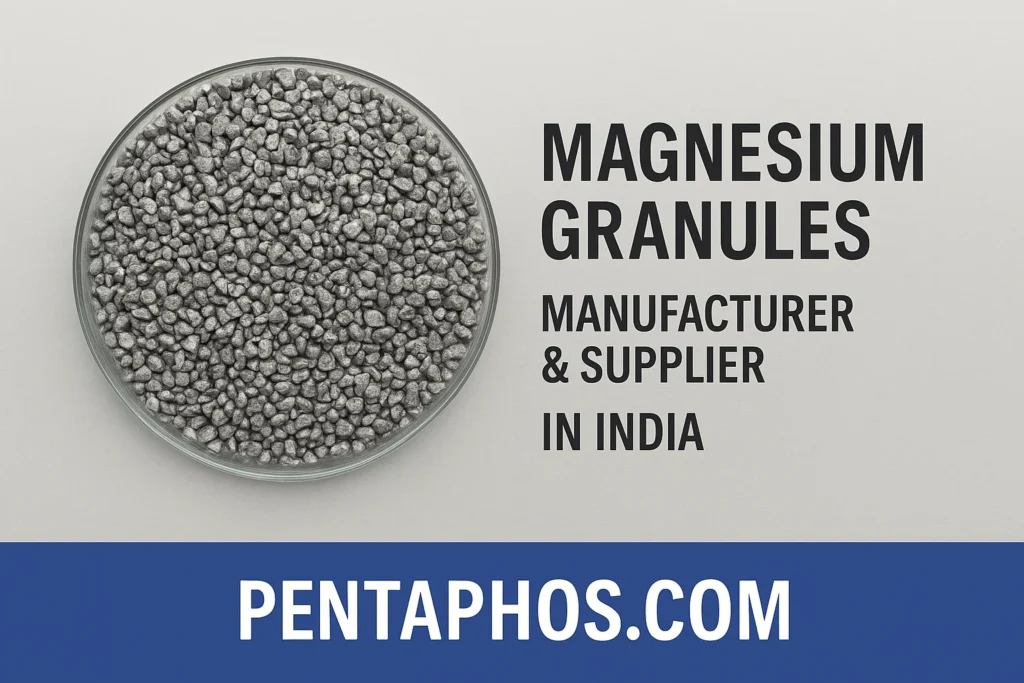
In the rapidly evolving landscape of Indian manufacturing and metallurgy, Magnesium Granules have emerged as a critical raw material, driving efficiency and innovation across sectors. From the sprawling steel plants to advanced chemical synthesis units, the demand for high-purity, consistently graded magnesium granules is at an all-time high. However, finding a reliable Magnesium Granules Manufacturer in India who can guarantee quality, timely supply, and technical expertise remains a significant challenge for many procurement managers and engineers. This comprehensive guide delves deep into the world of magnesium granules production and supply in India. We will explore what sets apart a premium manufacturer, the intricate manufacturing process, detailed pricing, and how to identify the right Magnesium Granules Supplier in India for your specific industrial needs, with a special focus on why Pentaphos.com stands as a leader in this specialized field. What are Magnesium Granules? Understanding the Product Magnesium granules are small, metallic particles of pure magnesium, typically ranging in size from 0.2 mm to 5.0 mm. Unlike powder, granules offer a perfect balance between high reactivity (due to significant surface area) and safe handling characteristics. Their granular form minimizes dust explosion risks, reduces oxidation during storage, and allows for precise metering in automated processes—making them the preferred choice for most large-scale industrial applications. Key Specifications of Industrial-Grade Magnesium Granules: The Role of a Specialist Manufacturer vs. a General Supplier This is a crucial distinction for buyers. A general supplier may source from various mills and repackage products, often leading to inconsistencies in quality and supply chain bottlenecks. A specialist manufacturer like Pentaphos, on the other hand, controls the entire production process—from sourcing raw magnesium ingots to granulation, grading, and quality assurance. Advantages of Partnering with a Direct Manufacturer: Inside the Manufacturing Process at PentaphosAt Pentaphos, our manufacturing philosophy is built on precision and purity. Here’s a step-by-step look at our process:Raw Material Selection: We begin with certified 99.8% pure magnesium ingots, sourced from trusted partners.Melting & Purification: The ingots are melted in a controlled atmosphere furnace to prevent oxidation, with fluxing agents used to remove any trace impurities.Granulation: The molten magnesium is subjected to a proprietary atomization and cooling process. This critical step determines the granule shape, size distribution, and surface characteristics. We use advanced techniques to achieve the desired spherical or irregular morphology.Screening & Grading: The granules pass through a multi-deck, precision vibrating screen system to segregate them into exact size fractions as per customer specifications or standard grades.Quality Assurance: Every batch undergoes rigorous testing:Chemical Analysis: Spectrometry to verify purity and trace element levels.Size Analysis: Sieve analysis to confirm particle size distribution.Reactivity Test: To ensure performance consistency in end applications.Passivation & Packaging: A mild surface passivation is applied (if required) to enhance shelf-life. Granules are immediately packed in moisture-proof, nitrogen-flushed containers to preserve their metallic lustre and reactivity. Applications: Where Indian Industries Use Magnesium Granules The versatility of magnesium granules makes them indispensable. As a leading Magnesium Granules Supplier India, we cater to: Price Chart: Magnesium Granules in India (2024) The price of magnesium granules varies based on purity, quantity, size grading, and market dynamics. Below is a transparent breakdown to help you budget. Grade / Specification Purity Size Range Price Range (₹ per Kg) Minimum Order Quantity Standard Industrial Grade 99.8% Min 1 – 4 mm ₹ 260 – ₹ 320 500 Kg Premium Reactivity Grade 99.9% Min 0.5 – 2 mm ₹ 340 – ₹ 410 250 Kg Custom Size (Fine) 99.8% Min 0.2 – 1 mm ₹ 310 – ₹ 370 300 Kg Custom Size (Coarse) 99.8% Min 3 – 5 mm ₹ 250 – ₹ 310 500 Kg Bulk Order Discount 99.8% Min As per grade Negotiated 5 MT+ Prices are EXW and subject to change based on LME magnesium prices and order specifics. Packaging costs extra. Contact Pentaphos for a real-time quote. Pros and Cons of Sourcing Magnesium Granules Pros: Cons: Why Choose Pentaphos as Your Magnesium Granules Partner? When you decide to Buy Magnesium Granules India, choosing Pentaphos offers unparalleled advantages: Frequently Asked Questions (FAQ) Q1: What is the typical lead time for ordering magnesium granules from Pentaphos?A: For standard grades, we maintain stock for delivery within 3-5 days across India. Custom sizes or large bulk orders require 7-14 days for production and dispatch. Q2: How should I store magnesium granules upon delivery?A: Store in a cool, dry, and well-ventilated warehouse. Keep drums sealed until use. Avoid storage near acids, chlorides, or other oxidizers. For very long storage, consider a dry, inert atmosphere. Q3: Can you provide material safety data sheets (MSDS) and certificates of analysis?A: Absolutely. We provide a comprehensive MSDS and a batch-specific Certificate of Analysis (CoA) with every shipment, detailing purity, size analysis, and other key parameters. Q4: Do you offer export services for magnesium granules?A: Yes, Pentaphos is a recognized exporter. We handle all documentation, packaging (as per IMDG code), and logistics for seamless export to global destinations. Q5: What is the difference between your granules and what’s available in the local market?A: The difference lies in consistency and purity. Local markets often deal in recycled or non-graded material. Our granules are made from primary magnesium, with strict size grading and certified purity, ensuring predictable performance in your process. Q6: Can you develop a custom alloy granule for our specific application?A: Yes, our R&D team specializes in developing custom magnesium-based alloys in granular form. Contact us with your technical requirements for a feasibility discussion. Conclusion: Your Strategic Decision for Quality and Reliability Choosing the right Magnesium Granules Manufacturer and Supplier in India is not just a procurement decision; it’s a strategic partnership that impacts your product quality, process efficiency, and bottom line. In a market filled with options, Pentaphos distinguishes itself through unwavering commitment to quality, transparency in pricing, and a customer-centric approach. We invite you to move beyond being just another buyer. Partner with a manufacturer who understands the science behind the granules and the stakes of your industry. Contact Pentaphos today to request samples, discuss your technical needs,

High Purity Metal Suppliers in India
Blog

High Purity Metal Suppliers in India

In the world of advanced manufacturing, purity defines performance. Whether you’re producing semiconductors, specialty chemicals, or aerospace components, the quality of your metal input determines the reliability of your final product. That’s why high-purity metals have become the cornerstone of modern technology. As one of the leading high-purity metal suppliers in India, Pentaphos Industries takes pride in providing premium-quality, precisely refined metals that meet stringent industrial standards. In this detailed guide, we’ll cover everything you need to know — from definitions, applications, benefits, and prices to how to choose the right supplier. 1. What Are High-Purity Metals? High-purity metals are metals refined to remove all unwanted elements and impurities such as oxygen, carbon, sulfur, nitrogen, and trace elements. Their purity typically ranges from 99.9% (3N) to 99.9999% (6N) depending on the intended use. Purity Grade Purity Percentage Common Usage 3N 99.9% General electronics, coatings 4N 99.99% Research, laboratory, catalysts 5N 99.999% Semiconductor, aerospace 6N+ 99.9999% Ultra-sensitive electronic and optical devices Even the tiniest impurity can alter conductivity, cause corrosion, or reduce material strength. Therefore, high-purity metals are indispensable for precision manufacturing and R&D. 2. Why High-Purity Metals Are Important High-purity metals are not just cleaner versions of regular metals — they’re technological enablers. Here’s why industries depend on them: 3. Pentaphos Industries – Your Trusted Partner for High-Purity Metals Pentaphos Industries has emerged as a trusted high-purity metal supplier in India, specializing in magnesium reagents, specialty chemicals, and pure metal derivatives. Our Core Strengths: At Pentaphos, our mission is simple — to deliver purity, precision, and performance. 4. Common Types of High-Purity Metals We Supply We provide a wide range of high-purity metals and alloys suitable for research, production, and industrial applications. Metal Available Purity Form Common Applications Magnesium 99.9% – 99.999% Granules, Powders Pharmaceuticals, Catalysts, Alloys Copper 99.99% – 99.9999% Wire, Rods Electrical & Electronics Aluminum 99.99% – 99.999% Sheets, Foils Aerospace, Coatings Indium 99.999% Ingots Semiconductors, LCDs Zinc 99.99% Blocks, Pellets Galvanization, Research Nickel 99.9% Plates, Bars Superalloys, Batteries Iron (Electrolytic) 99.9% Powder, Flakes Automotive, Sintered Components Tin / Tungsten / Germanium 99.9%+ Powder / Chips Optics, Electronics, Research All materials undergo ICP, GDMS, and spectrographic testing to ensure verified purity. 5. How High-Purity Metals Are Produced Producing ultra-clean metals requires multi-step refining techniques such as: Each batch is analyzed and verified before dispatch to ensure consistent quality. 6. Applications of High-Purity Metals Industry Application Benefit Pharmaceutical Catalyst & reagents Higher product purity Electronics Circuit boards, connectors Better conductivity Aerospace Engine components Strength + weight optimization Optics Coating mirrors, lenses Reflectivity and clarity Battery Industry Cathode materials Higher efficiency Automotive Sensors, coatings Improved performance These metals are crucial for ensuring consistent quality and performance in mission-critical environments. 7. Market Overview: High-Purity Metal Industry in India India’s demand for high-purity metals is rising rapidly due to: While India imports certain high-end metals, local suppliers like Pentaphos Industries are bridging the gap by offering globally competitive products with faster delivery and affordable pricing. 8. Pricing of High-Purity Metals in India (Indicative) Metal Purity Approx. Price (INR/kg) Remarks Magnesium (High Purity) 99.9% – 99.999% ₹1,500 – ₹5,000 Based on form and grade Indium (5N) 99.999% ₹20,000 – ₹70,000 Semiconductor quality Electrolytic Iron 99.9%+ ₹500 – ₹2,000 Automotive & research Aluminum 99.99% ₹400 – ₹1,200 Aerospace coating use Copper 99.999% ₹800 – ₹2,500 Electrical applications Note: Prices fluctuate depending on purity, global metal indices, and order volume. For accurate pricing, request a customized quote from Pentaphos Industries. 9. Advantages of Buying from Indian Suppliers ✅ Pros ⚠️ Cons Still, domestic suppliers like Pentaphos are continuously upgrading technology to match global purity standards. 10. Quality Control & Certification At Pentaphos Industries, we ensure total quality management (TQM) at every stage. Quality Measures: Our high-purity materials meet international standards like ASTM, ISO, and REACH, ensuring global acceptance. 11. Packaging and Handling Purity is only as good as its protection.Hence, we follow world-class packaging practices: This ensures that the material reaches you as pure as it left our plant. 12. Pros and Cons of Sourcing High-Purity Metals Pros Cons Superior performance and conductivity Higher cost compared to standard grades Enhanced product lifespan Requires special storage Better corrosion resistance Limited global suppliers Improved reliability Complex purification process High-purity metals may be expensive, but their value in critical applications far outweighs the cost. 13. How to Choose the Right High-Purity Metal Supplier Before choosing a supplier, evaluate these criteria: A supplier that checks all these boxes ensures a long-term partnership based on trust and results. 14. Why Choose Pentaphos Industries Here’s why global and Indian companies prefer us: Pentaphos Industries combines Indian efficiency with international standards. 15. Frequently Asked Questions (FAQ) Q1. What purity levels do you offer?We supply metals from 99.9% to 99.9999%, depending on customer requirements. Q2. Can I get small sample quantities?Yes, we provide trial batches for testing and R&D purposes. Q3. How do you verify metal purity?We use ICP-OES, GDMS, and spectrographic testing to measure impurities. Q4. What industries do you serve?Pharmaceutical, chemical, electronics, aerospace, research, and energy sectors. Q5. Do you provide documentation?Every shipment includes COA, MSDS, and complete batch traceability. Q6. Are your products export-ready?Yes. We follow international packaging and export standards. Q7. What are your payment and delivery terms?Flexible terms depending on order size, with typical lead times of 2–4 weeks. 17. Conclusion In a world where technology demands precision, reliability, and safety, high-purity metals form the foundation of innovation.For industries seeking consistent quality, verified purity, and trusted support, Pentaphos Industries stands out as a leading high-purity metal supplier in India. Our commitment to purity, performance, and partnership makes us the preferred choice for clients across pharmaceuticals, electronics, and advanced materials. 🌐 Explore Our Range Visit ➤ https://pentaphos.com/📞 Contact Us: For custom quotations, technical support, or bulk inquiries.

Buy Magnesium Online in Bulk
Blog

Buy Magnesium Online in Bulk

Magnesium is one of the most essential and versatile metals in the modern industrial world. From pharmaceutical manufacturing to metal refining, chemical synthesis, agriculture, and energy storage, magnesium plays a crucial role across multiple sectors. If you’re searching for the best place to buy magnesium online in bulk, you’ve reached the right destination. At Pentaphos, we specialize in supplying high-purity magnesium for industrial and laboratory applications — ensuring consistent quality, reliable logistics, and cost-effective pricing. This comprehensive guide explains everything you need to know about buying magnesium in bulk — including price trends, sourcing process, benefits, safety, and FAQs — helping you make an informed decision. 🧪 What Is Magnesium? Magnesium (symbol Mg, atomic number 12) is a lightweight, silvery-white metal known for its strength-to-weight ratio and excellent chemical reactivity. It’s the eighth most abundant element in the Earth’s crust, and its compounds are used extensively in both industrial and biological systems. When processed into powder, flakes, or turnings, magnesium becomes a powerful reducing agent and alloying material. It’s widely used to manufacture automotive parts, aerospace alloys, fireworks, fertilizers, and pharmaceuticals. ⚙️ Why Buy Magnesium in Bulk? 1. Cost Efficiency Buying magnesium in bulk significantly reduces the per-kg cost, allowing businesses to save on packaging, logistics, and handling charges. Bulk buyers also enjoy wholesale discounts and custom delivery terms. 2. Quality Consistency Bulk sourcing ensures you receive a single, consistent production batch, which means better control over quality and chemical specifications. 3. Stable Supply Chain When you buy in bulk, you minimize risks related to market shortages, shipping delays, or raw material price spikes — ensuring steady production. 4. Customization Bulk orders allow custom packaging, purity grades, and particle sizes, which are often unavailable in retail quantities. 5. Industrial-Grade Certifications Suppliers like Pentaphos provide Certificates of Analysis (CoA), Safety Data Sheets (MSDS), and purity reports, ensuring compliance with regulatory standards. 🔍 Types of Bulk Magnesium Available The right form of magnesium depends on your industry and intended application. Below is a detailed overview: Type of Magnesium Purity Common Uses Features Magnesium Metal Powder 99%–99.9% Pyrotechnics, chemical reduction, alloy manufacturing Fine reactive powder, highly flammable Magnesium Turnings / Chips 99% Industrial reduction, foundry applications Economical, coarse particles Magnesium Oxide (MgO) 90%–99% Pharmaceuticals, fertilizers, ceramics Non-combustible, stable oxide Magnesium Sulphate (Epsom Salt) 98%+ Agriculture, personal care, food industry Water-soluble, non-hazardous Magnesium Chloride 95%+ De-icing, dust control, catalyst production Hygroscopic, moderate cost Magnesium Hydroxide 90%+ Flame retardant, wastewater treatment Low solubility, eco-friendly Magnesium Carbonate 95%+ Rubber, glass, food, cosmetics Fine powder, white pigment 💰 Bulk Magnesium Price Guide (2025) The price of magnesium varies based on purity, form, and market demand. Below is an indicative pricing chart to help you estimate your procurement cost. Quantity Form Purity Approx. Price per kg (INR) Approx. Price per kg (USD) 25 kg Magnesium Powder 99% ₹900 – ₹1,100 $10 – $13 100 kg Magnesium Powder 99% ₹750 – ₹900 $9 – $11 500 kg Magnesium Turnings 99% ₹600 – ₹750 $7 – $9 1 Ton (1,000 kg) Magnesium Powder 99% ₹500 – ₹600 $6 – $8 5 Ton Magnesium Oxide 95% ₹250 – ₹300 $3 – $4 10 Ton+ Magnesium Chloride 90% ₹150 – ₹200 $2 – $ 🧭 Factors That Influence Bulk Magnesium Prices 🧱 Applications of Bulk Magnesium 1. Metallurgical & Alloy Industry Used as an alloying element with aluminum, zinc, and manganese to create lightweight and strong components for automobiles, aerospace, and electronics. 2. Chemical Synthesis Magnesium is a crucial reducing agent in the production of Grignard reagents, pharmaceuticals, and fine chemicals. 3. Fertilizer & Agriculture Magnesium oxide and sulphate improve soil fertility by enriching magnesium levels — vital for chlorophyll production in plants. 4. Pharmaceuticals & Healthcare Magnesium salts (oxide, citrate, hydroxide) are used in antacids, laxatives, and nutritional supplements. 5. Construction & Flame Retardants Magnesium hydroxide acts as a non-toxic flame retardant in plastics, cables, and building materials. 6. Environmental Treatment Used in wastewater treatment for neutralization and heavy-metal precipitation. ✅ Advantages of Buying Bulk Magnesium from Pentaphos ⚖️ Pros & Cons of Buying Bulk Magnesium Pros Cons Cost-effective for large-scale use Requires larger upfront payment Reduced packaging waste Needs proper storage space Custom specifications possible Risk if supplier is unreliable Better quality control Safety management needed for powders Easy reordering & contract pricing Transportation requires compliance 🔬 Safety & Handling Guidelines 📦 Packaging Options Packaging Type Capacity Features HDPE Bag 25 kg Moisture-resistant inner liner Fiber Drum 50 kg Rigid and reusable Jumbo Bag 500 kg – 1 Ton Ideal for bulk shipping Vacuum-Sealed Container Custom For ultra-pure magnesium powder 🚚 Ordering Process with Pentaphos 🌍 Global Supply Capability Pentaphos exports magnesium to multiple regions including: Each shipment is accompanied by export documentation, CoA, and quality assurance reports. 🔧 Technical Specifications (Example for Magnesium Powder) Property Specification Chemical Formula Mg Purity 99% – 99.9% Particle Size 80 – 300 mesh Density 1.74 g/cm³ Melting Point 650 °C Boiling Point 1090 °C Appearance Silvery-grey powder Solubility Insoluble in water Storage Cool, dry, inert environment 🧠 Tips for First-Time Bulk Buyers ❓ Frequently Asked Questions (FAQ) Q1. What is the minimum order quantity (MOQ)?A: For bulk orders, Pentaphos offers flexible MOQs starting from 25 kg up to multi-ton shipments. Q2. Can I get magnesium in custom purity levels?A: Yes, we can supply magnesium between 98% to 99.9%+ purity, depending on your industrial requirement. Q3. How do I store bulk magnesium safely?A: Keep in airtight containers, away from water, acids, and oxidizing agents. Store in a dry, inert atmosphere. Q4. What is the delivery timeline?A: Standard orders are delivered within 7–15 business days across India, while export orders depend on destination port. Q5. Does Pentaphos offer technical support?A: Yes. Our technical team assists with handling, safety training, and product compatibility guidance. Q6. Can I get a sample before bulk purchase?A: Absolutely. Samples can be provided for lab testing before placing a full-scale order. Q7. Which industries commonly buy magnesium in bulk?A: Chemical manufacturers, metal foundries, supplement producers, fertilizer companies, and R&D labs.

Magnesium supplier for chemical industry
Blog

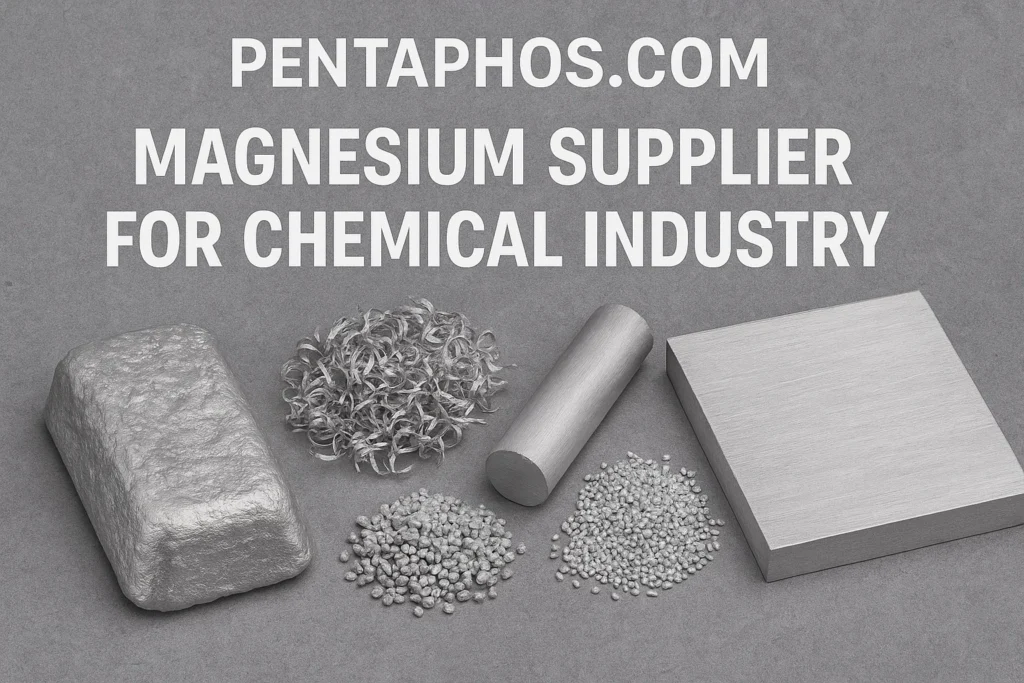
Magnesium supplier for chemical industry

In the modern era of chemical manufacturing, magnesium and its derivatives play a pivotal role across multiple applications — from catalysts and reagents to specialty materials and alloying components. As demand surges for high-performance materials and lighter, more efficient industrial processes, the role of a reliable magnesium supplier becomes critical. Pentaphos aims to position itself as a leading supplier of magnesium and magnesium derivatives tailored for the chemical industry—providing quality, consistency, regulatory compliance, and competitive pricing. This article describes all aspects of magnesium supply in the chemical domain, and positions Pentaphos as the trusted partner. 2. Importance of Magnesium in the Chemical Industry 2.1 Fundamental Properties of Magnesium Magnesium (Mg) is a silvery-white, lightweight metal that is highly reactive (especially in powdered or molten state). It is the lightest structural metal, with a density of about 1.74 g/cm³. Key physical and chemical characteristics: Property Value / Description Atomic number 12 Atomic weight ~24.305 g/mol Density ~1.74 g/cm³ Melting point ~650 °C Boiling point ~1,091 °C Thermal conductivity High Reactivity Highly reactive with oxygen, water, acids Oxidation tendency Forms oxide/hydroxide surface layer Because of its unique combination of lightweight and good mechanical strength (especially in alloys), magnesium is widely used in structural, electronic, and chemical contexts. 2.2 Why the Chemical Industry Requires Magnesium In chemical processes, magnesium and its compounds serve several functions: Because these functions require high purity, consistency, proper particle sizes, and stable supply, choosing the right supplier is critical. 3. Global & Indian Market Overview 3.1 Global Magnesium Supply Landscape Magnesium production typically uses two main routes: Despite its utility, magnesium production is energy-intensive and subject to environmental regulations and input supply constraints. Market dynamics are influenced by: 3.2 Trends in Magnesium Derivative Markets 3.3 The Indian Context & Domestic Supply India, with its active chemical and metallurgical industries, has local magnesium suppliers and intermediates producers. For instance: Given this landscape, a competitive supplier must combine local sourcing efficiencies, quality assurance, logistical capability, and regulatory compliance. 4. Forms, Grades & Specifications of Magnesium Not all “magnesium” is the same. For chemical industry use, the physical form, purity, particle size, moisture content, and specification standards matter critically. 4.1 Physical Forms Some common forms / derivatives used in chemical industry: 4.2 Purity & Grades Chemical industry demands vary by use. Typical grades include: You should publish your standard product specifications for each grade—this helps SEO (keywords like “MgO 99.5% purity”, “granule size”, “analytical grade magnesium”) and builds buyer confidence. 4.3 Specification Table (Example) Here’s an example spec table you can adapt: Property Unit / Condition Typical Value (Industrial Grade) Typical Value (High Purity) Assay (Mg or MgO) wt% 90–98% ≥ 99.5% Moisture wt% ≤ 1.0% ≤ 0.2% Loss on ignition wt% ≤ 2.0% ≤ 0.5% Particle size μm / mesh 5–100 µm (or 20–200 mesh) 1–50 µm Fe (Iron) ppm ≤ 500 ppm ≤ 50 ppm Ca, Si, Al impurities ppm ≤ 100–500 ppm ≤ 20–100 ppm Na, K, Cl, S ppm ≤ 200–1000 ppm ≤ 10–100 ppm Bulk density g/cm³ ~0.5–1.0 ~0.5–0.8 Color / Appearance — White/off-white powder or granules White crystalline Ensure you publish these grades (and any custom grades) on your product pages to help SEO and buyer clarity. 5. Sourcing & Procurement Strategy To be a successful magnesium supplier (or to procure for your chemical operations), you should consider factors across the supply chain. 5.1 Raw Material Sourcing 5.2 Production & Processing 5.3 Supplier Network & Dual Sourcing 5.4 Risk Mitigation 6. Price Trends & Cost Components 6.1 Price Components The landed cost or supplier price of magnesium (or derivatives) comprises: 6.2 Recent Price Trends These are indicative — actual pricing depends heavily on grade, quantity, shipping, and contract terms. 6.3 Pricing Strategy for Pentaphos To maintain competitiveness and margin: 7. Advantages & Challenges (Pros & Cons) 7.1 Advantages (Pros) of Magnesium in Chemical Use & as Supplier 7.2 Challenges (Cons) & Risks In summary, while magnesium has compelling advantages, a supplier must manage multiple technical and operational challenges. Emphasizing quality, safety, and consistency will set you apart. 8. Quality Control, Certification & Testing To serve chemical industry clients, rigorous quality assurance is essential. Here’s what Pentaphos should emphasize: 8.1 Quality Standards & Certifications 8.2 Testing Methods & Parameters Providing detailed CoA and lab reports boosts buyer confidence and helps in SEO (keywords: “ICP analysis magnesium”, “CoA magnesium supplier”). 8.3 Batch Traceability & Quality Assurance Process 9. Logistics, Packaging & Storage 9.1 Packaging Options Packaging should prevent moisture ingress, clumping, contamination, and ensure safe handling. 9.2 Storage Conditions 9.3 Transportation & Shipment Considerations 10. Applications & Use Cases in Chemical Industry Here are common applications and use cases where magnesium supplied by Pentaphos will add value: 10.1 Magnesium Oxide (MgO) in Chemical Processes 10.2 Magnesium Hydroxide (Mg(OH)₂) 10.3 Magnesium Chloride / Sulfate / Carbonate 10.4 Metal / Alloy Applications 10.5 Sector-wise Use Cases Case example: a specialty polymer producer requires Mg(OH)₂ with tight particle size control and low metal impurities; Pentaphos provides a 1–10 µm grade with CoA and consistent delivery. 11. Environmental, Safety & Regulatory Considerations 11.1 Handling & Safety 11.2 Environmental & Emissions Controls 11.3 Regulatory & Trade Compliance Pentaphos should maintain all regulatory documentation and communicate to clients clearly. 12. Why Choose Pentaphos as Your Magnesium Supplier To position Pentaphos as the ideal partner, you can highlight these differentiators: You may include a section on “Partner With Pentaphos” with a call to action (CTA) to contact for quote, sample, or specification discussion. 13. Case Studies / Success Stories (You can insert actual clients or anonymized stories here. Example templates below.) Case Study 1: Specialty Polymer Manufacturer Challenge: Needed Mg(OH)₂ of average particle size 3 µm with < 50 ppm Fe, large volume, tight delivery schedule. Solution: Pentaphos supplied customized grade, delivered in multiple batches, and provided QC reports. Outcome: Polymer producer reported improved flame retardancy, lower defect rates, and stable cost. Case Study 2: Refractory / Furnace Lining Supplier Challenge: Required high-purity, fused MgO for high-temp kiln linings with consistent thermal expansion.

Scroll to Top